






What's Happening?
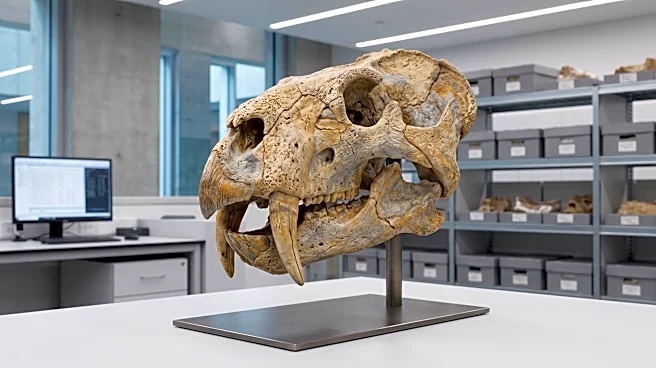
Paleontologists have identified a new species of dicynodont, named Dinodontosaurus isiyavamanda, from fossil specimens found in Tanzania's Manda Beds. This discovery marks the first confirmed record of the Dinodontosaurus genus outside South America,
where it was previously thought to be exclusively located. The new species, a plant-eating synapsid distantly related to modern mammals, lived approximately 240 million years ago during the Triassic period. The identification was made through detailed examination of a skull and partial skeleton collected in 1963 and a second specimen recovered in 2012, utilizing CT scanning and 3D surface imaging. Lead author Hady George, a Ph.D. student at the University of Bristol, stated that this finding links Tanzanian and South American fossil-bearing rocks, indicating they are of equivalent age. Dr. Mike Day, curator of non-mammalian tetrapods at the Natural History Museum, London, highlighted the significance of revisiting museum collections for new insights into the past.
Why It's Important?
The presence of Dinodontosaurus in Tanzania, a genus also found in securely dated rock sequences in Brazil and Argentina, suggests that the fossil-rich mid-to-upper layer of the Manda Beds is considerably younger than previously assumed. Historically, this layer was thought to be Anisian (247-242 million years ago), but the new evidence points to a late Ladinian (242-237 million years ago) to Carnian (237-227 million years ago) age. This re-dating is crucial because the Manda Beds have yielded what may be the oldest known dinosaur, Nyasasaurus parringtoni, along with other early dinosaur relatives. A younger age for these rocks implies that these early dinosaurs appeared later in Earth's history than some prior estimates. This shift in the timeline could necessitate a re-evaluation of the origins and evolutionary timelines of major Mesozoic clades, including the Dinosauria, impacting our understanding of early dinosaur diversification and global paleogeography.
What's Next?
Future paleontological research will need to consider this revised, younger age for the mid-to-upper Lifua Member of the Manda Beds when investigating the origins of major Mesozoic clades, including dinosaurs. This discovery underscores the ongoing importance of museum collections, as the specimens studied had been in care for over 60 years before their full significance was realized. Further analysis of existing and newly discovered fossils from the Manda Beds and comparable South American sites will likely focus on refining the chronological framework of the Triassic period and understanding the dispersal patterns of ancient fauna across the supercontinent Gondwana. The findings, published in the Journal of Vertebrate Palaeontology, will stimulate new discussions and research directions within the paleontology community regarding the timing of early dinosaur evolution and the interconnectedness of ancient ecosystems.
Beyond the Headlines
This discovery highlights the dynamic nature of scientific understanding, where new evidence can significantly alter long-held theories, even those based on extensive prior research. The re-dating of the Manda Beds not only impacts the timeline of dinosaur origins but also emphasizes the interconnectedness of ancient landmasses during the Triassic period, when South America and Africa were part of the supercontinent Gondwana. The shared presence of Dinodontosaurus across these now-separate continents provides compelling evidence for their geological connection and the widespread distribution of certain species. Furthermore, the study exemplifies the value of continuous re-examination of historical scientific collections with modern analytical techniques, demonstrating that even decades-old specimens can yield groundbreaking insights with advancements in technology like CT scanning and 3D surface imaging. This iterative process of discovery and re-evaluation is fundamental to advancing our knowledge of Earth's deep past.