








What's Happening?
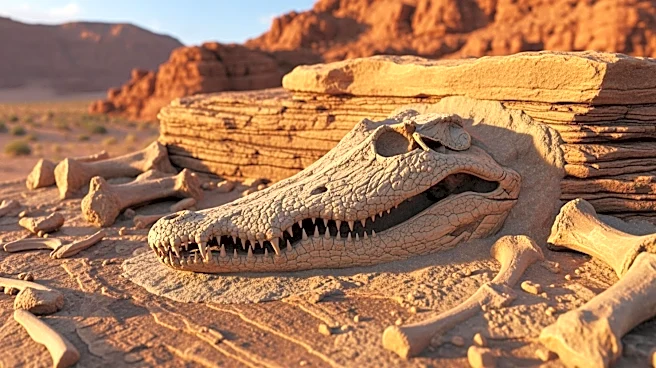
Paleontologists in New Mexico have discovered a new species of reptile, Labrujasuchus expectatus, which lived 212 million years ago during the Triassic period. This creature, a relative of modern crocodiles, was bipedal and had a toothless beak, resembling
a small dinosaur. The discovery was made at Ghost Ranch, a significant fossil site in northern New Mexico. Labrujasuchus is part of the Shuvosauridae group, known for their beaked, bipedal forms. This finding highlights the diversity and experimentation in body forms during the early stages of vertebrate evolution, particularly among proto-crocodiles.
Why It's Important?
The discovery of Labrujasuchus expectatus provides valuable insights into the evolutionary history of reptiles, particularly the crocodile lineage. It demonstrates convergent evolution, where similar body forms evolve independently in different lineages due to similar ecological pressures. This finding challenges the traditional view of evolutionary pathways and highlights the complexity of vertebrate evolution. It also underscores the importance of fossil sites like Ghost Ranch in understanding prehistoric life and the evolutionary processes that shaped modern biodiversity.
What's Next?
Further research and analysis of the Labrujasuchus fossils are expected to provide more detailed insights into the evolutionary adaptations of early crocodile relatives. Paleontologists may continue to explore Ghost Ranch and similar sites to uncover additional fossils that could fill gaps in the evolutionary timeline. Collaboration among scientists will likely continue to enhance understanding of the Triassic period's ecological dynamics and the evolutionary history of reptiles.
Beyond the Headlines
The discovery of Labrujasuchus expectatus highlights the broader implications of convergent evolution, suggesting that certain ecological niches may lead to similar evolutionary outcomes across different lineages. This finding may influence future studies in evolutionary biology, prompting researchers to reconsider assumptions about the uniqueness of evolutionary paths. Additionally, it emphasizes the role of paleontology in uncovering the hidden diversity of ancient ecosystems and the evolutionary experiments that occurred millions of years ago.