







What's Happening?
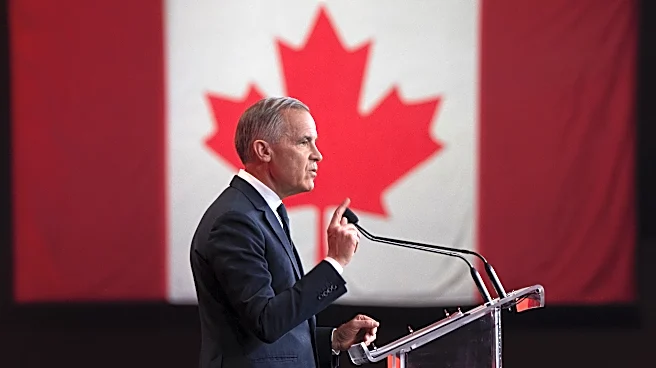
Canadian Prime Minister Mark Carney has successfully secured a majority government following special election wins. The Liberal Party, led by Carney, won two key seats in Toronto, with results from a Quebec district still pending. This victory allows
the Liberals to pass legislation without needing support from opposition parties. Carney's leadership has been marked by a shift to the center-right since he replaced Justin Trudeau in 2025. His election success last year was largely fueled by public discontent over President Trump's annexation threats, prompting Carney to focus on reducing Canada's reliance on the U.S. The recent defections from opposition parties, including the Conservatives, have bolstered Carney's position, enabling him to consolidate power and potentially remain in office until 2029.
Why It's Important?
The establishment of a majority government under Prime Minister Carney is significant for Canada's political landscape, particularly in the context of strained relations with the U.S. under President Trump. Carney's ability to pass legislation without opposition support could lead to more decisive governance and policy implementation. This shift may impact Canada's economic strategies, especially in reducing dependency on the U.S. market. The political stability provided by a majority government could enhance Canada's ability to navigate international challenges and strengthen its position on the global stage. The defections from the Conservative Party highlight internal challenges and could lead to further political realignments within Canada.
What's Next?
With a majority government, Prime Minister Carney is expected to advance his economic and policy agenda more effectively. This may include initiatives aimed at diversifying Canada's international trade relationships and reducing economic reliance on the U.S. The Liberal Party's strengthened position could lead to more robust legislative actions in areas such as economic reform and international diplomacy. The Conservative Party, facing internal challenges, may need to reassess its strategies and leadership to regain political ground. The upcoming results from the Quebec district could further solidify Carney's majority, potentially influencing future political dynamics in Canada.
Beyond the Headlines
The shift in Canada's political landscape under Carney's leadership may have broader implications for North American relations. As Canada seeks to reduce its reliance on the U.S., there could be increased efforts to strengthen ties with other international partners. This realignment may affect trade policies and diplomatic strategies, potentially leading to new alliances and economic opportunities. The political stability provided by a majority government could also foster long-term policy initiatives aimed at addressing domestic issues such as economic inequality and social justice. Carney's centrist approach may influence the ideological direction of Canadian politics, impacting future electoral outcomes.