




What's Happening?
A new report, 'Breaking the Ice? The future of trans-Arctic shipping and implications for the EU,' by Systemiq with economic modeling from the University of Oxford Environmental Change Institute, suggests that trans-Arctic shipping will account for less
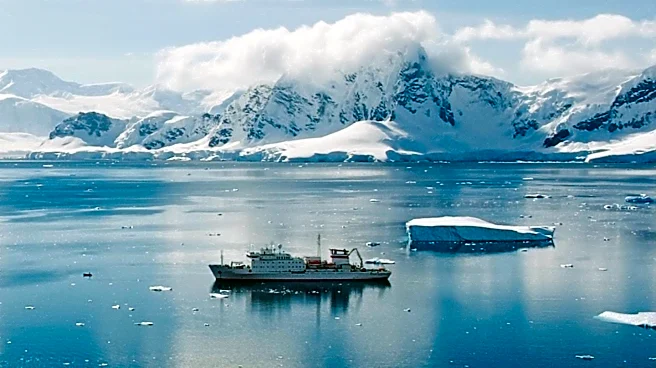
than 0.2% of global maritime trade by value in 2050, with annual industry savings of only $100 million. This research indicates that while Arctic routes offer significant distance savings, these do not necessarily translate into lower costs. Factors such as the need for ice-capable vessels, higher insurance premiums, slower speeds, and limited infrastructure undercut commercial attractiveness. Boris Vergote, a senior manager at Systemiq, highlighted that diverting ships through the Arctic could disrupt complex global container shipping networks, which rely on predictability and multiple ports of call. The report emphasizes that environmental and geopolitical risks remain substantial, including black carbon emissions accelerating ice melt, noise and light disturbing marine wildlife, and the challenges of oil spill cleanup in icy waters. Geopolitically, the Northern Sea Route largely traverses Russian waters, and China is increasingly interested in Arctic shipping, with all three routes passing through the Bering Strait between Russia and the United States.
Why It's Important?
The findings are important for U.S. and international policy-makers, businesses, and environmental stakeholders as they challenge the perception of the Arctic as a commercially viable shipping highway. The limited economic benefits, coupled with significant environmental and geopolitical risks, suggest that the anticipated 'rewards' of a melting Arctic may be largely overstated for the shipping industry. For the U.S., the geopolitical implications are particularly relevant given the Bering Strait's strategic location as a potential chokehold between Russia and the United States. Environmentally, the report underscores the fragility of the Central Arctic Ocean, warning that increased shipping could exacerbate climate change through black carbon emissions and harm marine ecosystems. This analysis provides a critical perspective for investment decisions and regulatory frameworks concerning Arctic development, potentially discouraging large-scale commercial ventures that might otherwise be pursued under the assumption of substantial economic gains. It highlights the need for proactive governance to prevent commercial pressures from making future environmental restrictions harder to implement.
What's Next?
The European Union, having recently adopted its new Arctic Strategy, is urged by Systemiq to proceed cautiously, especially regarding the Transpolar Route. The EU is already advocating for stricter regulations on black carbon emissions, and the report calls for additional safeguards against noise and light pollution, as well as tighter restrictions on heavy fuel oil. Former European Commissioner for Maritime Affairs and Fisheries Maria Damanaki stressed that Arctic shipping must not compromise the EU’s existing climate commitments. Decisions on these matters are expected to take time as the EU balances the interests of its member states and other policy objectives. The report advocates for proactive governance to establish new restrictions before commercial pressures make such measures more difficult to introduce. This suggests a future where regulatory bodies may impose more stringent environmental and operational standards on any Arctic shipping activities.
Beyond the Headlines
Beyond the immediate commercial and environmental considerations, this research touches upon deeper ethical and long-term implications. The notion of a 'shortcut through the Arctic' as a viable option is being critically re-evaluated, suggesting a shift in how humanity perceives and interacts with pristine, vulnerable environments. The report implicitly raises questions about the true cost of economic shortcuts when weighed against irreversible environmental damage and complex geopolitical tensions. The emphasis on 'proactive governance' before commercial pressures become entrenched highlights a growing recognition of the need for anticipatory policy-making in the face of climate change and resource exploitation. This could set a precedent for how other sensitive global regions are managed, prioritizing ecological preservation and long-term sustainability over short-term economic gains. The study also underscores the interconnectedness of global systems, where regional environmental changes in the Arctic have far-reaching economic, political, and ecological consequences.