
What's Happening?
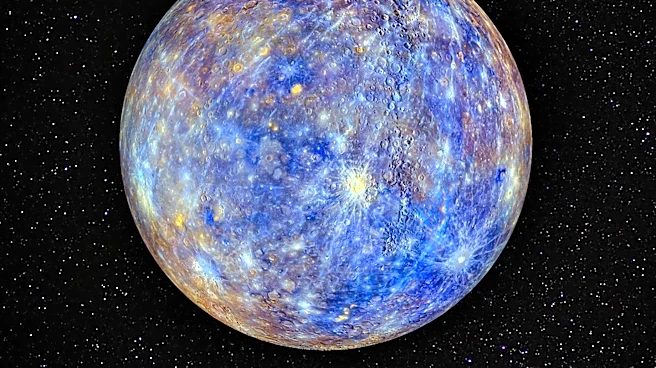
New research from scientists at the German Aerospace Center’s (DLR) Institute of Space Research indicates that the planet Mercury is shrinking at a faster rate than previously estimated. The planet, already
the smallest in our solar system, has lost up to 14.5 miles in total diameter since its formation billions of years ago. This revised rate is 10 to 30 percent more than earlier calculations. Scientists suggest that debris from impact craters may have obscured the true extent of this accelerated shrinking. The process is largely attributed to Mercury losing heat, causing its outer layer of hard rock to resist deflation and form cracks and wrinkles on its surface. These surface features, including steep cliffs (scarps) and ridges, have made it challenging to accurately assess the overall shrinkage. By aggregating previous maps of Mercury's surface, the team found that rougher areas had fewer wrinkles, implying that impact debris was concealing shortening structures. The European Space Agency and Japan Aerospace Exploration Agency’s BepiColombo mission, launched in 2018, is expected to enter Mercury’s orbit in November, providing an opportunity for closer observation.
Why It's Important?
The accelerated shrinking of Mercury has significant implications for understanding the planet's internal structure and evolutionary history. A faster rate of shrinkage suggests that Mercury could possess a larger metal core, contain fewer light elements like silicon mixed into its core, or have had a higher initial temperature. This new data helps refine physics-based predictions about planetary cooling and composition. For planetary scientists, understanding the rate of Mercury's contraction is crucial for deciphering its formation and evolution. As Brown University planetary geoscientist Sam Birch noted, knowing how fast Mercury is shrinking allows scientists to infer its cooling rate, original size, and material composition. This research contributes to the broader field of planetary science, offering insights into the diverse geological processes that shape celestial bodies and potentially informing our understanding of other rocky planets in and beyond our solar system.
What's Next?
The European Space Agency and Japan Aerospace Exploration Agency’s BepiColombo mission is scheduled to enter Mercury’s orbit in November. This mission will be only the second spacecraft in human history to orbit Mercury, providing an unprecedented opportunity for close-up observations. The data collected by BepiColombo is expected to offer valuable insights into the planet's ongoing geological processes, including its shrinkage. Scientists anticipate that the mission will help validate or further refine the new findings regarding Mercury's contraction rate and internal composition. Future research will likely focus on utilizing the detailed imagery and measurements from BepiColombo to create more precise models of Mercury's interior and surface evolution. This will enable a deeper understanding of how the planet's heat loss drives its physical changes and how these changes manifest on its surface, potentially revealing more about the obscured shortening structures.
Beyond the Headlines
The study of Mercury's rapid shrinkage extends beyond mere planetary dimensions, touching upon fundamental questions about planetary thermodynamics and material science under extreme conditions. The 'like a balloon left out in the cold' analogy highlights the planet's unique cooling mechanism, where its hard rock outer layer resists contraction, leading to surface fracturing. This phenomenon offers a natural laboratory for studying stress and strain in planetary crusts. Furthermore, the challenges in accurately measuring Mercury's shrinkage due to impact debris underscore the complexities of geological mapping on celestial bodies with active surface processes. The insights gained from Mercury's evolution could potentially inform models of other rocky planets, including Earth, by providing comparative data on how internal heat loss influences surface features and overall planetary dynamics over billions of years. This research also emphasizes the continuous refinement of scientific understanding as new data and observational techniques become available.