

What's Happening?
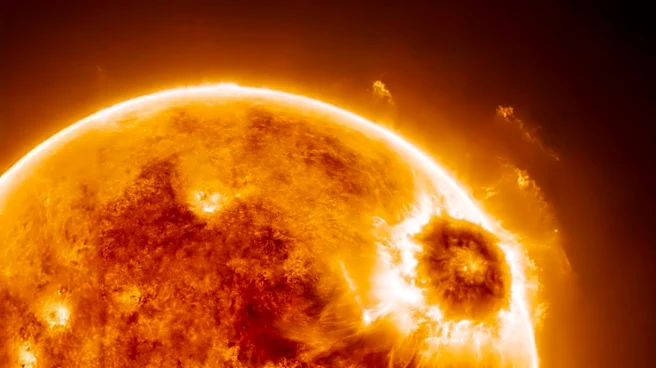
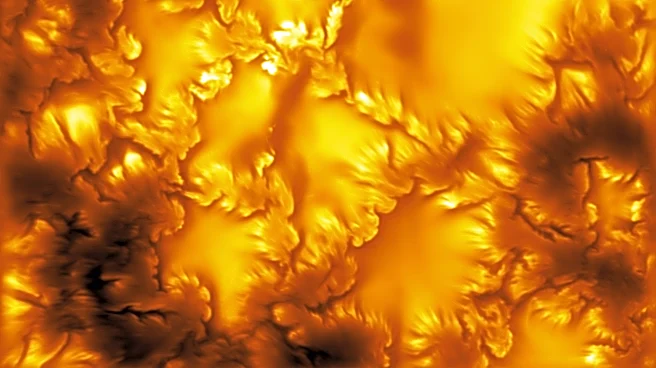
Researchers from the U.S. National Science Foundation National Solar Observatory and the Max Planck Institute for Solar System Research have discovered tiny plasma vortices on the sun's surface using the NSF Daniel K. Inouye Solar Telescope. These vortices,
occurring at the edges of solar granules, are linked to Kelvin–Helmholtz instabilities, a fluid dynamics effect. The discovery provides a new perspective on how the sun stores and releases energy in its magnetic field, potentially explaining the twisting of magnetic field lines that lead to nanoflares.
Why It's Important?
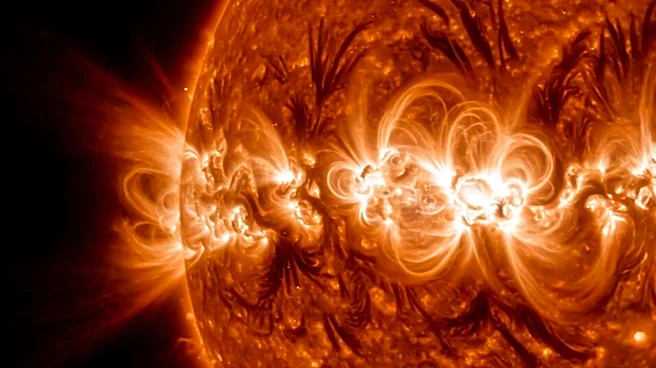
Understanding these plasma vortices could significantly advance knowledge of solar magnetic activity, which affects space weather and has implications for satellite operations and communication systems on Earth. The vortices may play a crucial role in the rapid diffusion of magnetic flux, influencing the sun's 11-year activity cycle. This discovery could lead to improved models of solar behavior, enhancing predictions of solar storms and their impact on Earth.
What's Next?
Further research will likely focus on the role of these vortices in solar magnetic dynamics and their potential impact on space weather. Continued observations and simulations could refine models of solar activity, aiding in the development of better predictive tools for space weather forecasting.