


What's Happening?
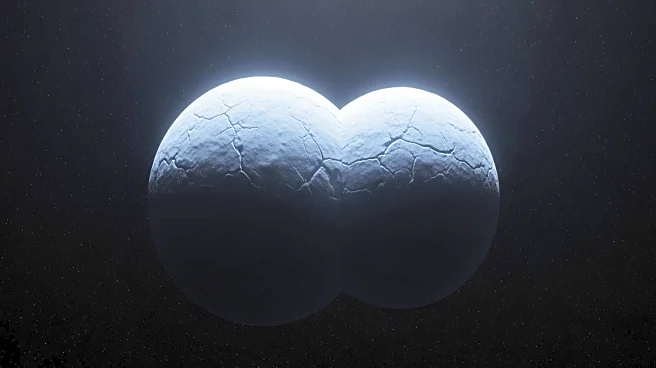
Researchers have gained new insights into the formation of Arrokoth, a snowman-shaped body in the Kuiper belt, through computer simulations. Arrokoth, a 4 billion-year-old object, is believed to have formed through gravitational collapse, resulting in its
distinctive double-lobed shape. The Kuiper belt, located beyond Neptune, is home to many dwarf planets and planetesimals, the building blocks of planets. The simulations show that gravitational forces within rotating clouds of pebbles caused them to form into clumps, eventually leading to the formation of double-lobed planetesimals like Arrokoth.
Why It's Important?
The study supports the theory that planetesimals in the Kuiper belt formed through gravitational collapse, providing a deeper understanding of the processes that shaped the early solar system. The findings have implications for the study of other double-lobed objects in the Kuiper belt, which make up 10-25% of the planetesimals in the region. Understanding the formation of these objects can shed light on the conditions and processes that were present during the early stages of planetary formation.
Beyond the Headlines
The research highlights the importance of considering the physics of particle interactions in simulations of gravitational collapse. Previous simulations did not account for how particles rest upon each other, leading to different conclusions about the formation of planetesimals. The study also suggests that gravitational collapse is a common mechanism for the formation of planetesimals, supporting long-held views in planetary science.