


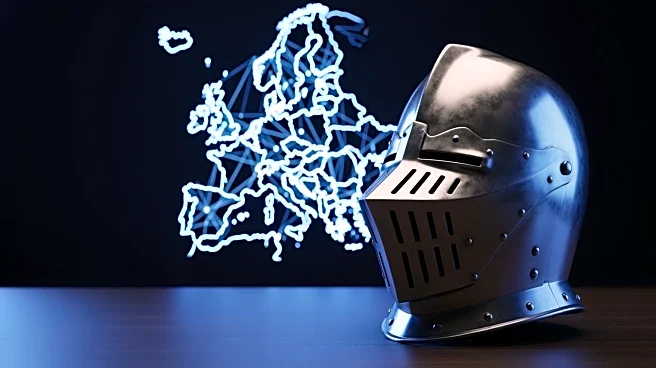
What's Happening?
NATO is facing a pivotal moment as European allies are urged to take on greater defense responsibilities. The 2026 National Defense Strategy indicates that while the United States will continue to support NATO, it is pressing European nations to increase
their defense spending and capabilities. This shift comes amid broader global challenges that require the U.S. to focus on multiple regions, including the Middle East and Asia. European countries, such as Britain and France, have already begun to step up, exemplified by their recent joint operation to enforce sanctions on Russian oil. The strategy emphasizes that the U.S. will not abandon NATO but seeks a more balanced partnership where European allies are more self-reliant in their regional defense.
Why It's Important?
The call for increased European military responsibility is significant as it reflects a strategic realignment in U.S. foreign policy. This move could lead to a stronger, more autonomous Europe capable of addressing regional security threats without over-reliance on U.S. military support. It also highlights the necessity for Europe to enhance its hard power to complement its soft power strategies, especially in light of past missteps in handling relations with Russia and Ukraine. The shift could redefine transatlantic relations and ensure NATO's resilience in a multipolar world where the U.S. must address diverse global challenges.
What's Next?
European nations are expected to continue increasing their defense budgets and capabilities, potentially leading to a more robust and independent European military presence. This evolution may influence ongoing geopolitical negotiations, such as those involving Ukraine, where European countries could play a more active role. The U.S. will likely maintain its strategic support while encouraging Europe to assume greater responsibility for its security. This transition could also prompt discussions within NATO about its future structure and the roles of its members.
Beyond the Headlines
The strategic shift towards greater European military autonomy raises questions about the long-term implications for NATO's cohesion and effectiveness. As Europe strengthens its military capabilities, it may also need to reassess its diplomatic strategies, particularly in dealing with Russia. The balance between hard and soft power will be crucial in maintaining stability and preventing conflicts. Additionally, this development could influence global perceptions of Western alliances and their ability to uphold democratic values and international order.