






What's Happening?
The Texas House Committee on Natural Resources convened in El Paso to discuss critical water issues affecting the region, including oversight of the Texas Commission on Environmental Quality (TCEQ), disputes over Rio Grande water access with New Mexico,
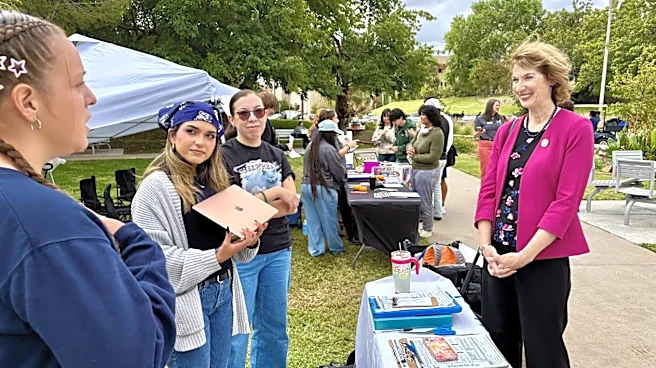
and strategies to increase water supply. State Rep. Mary Gonzalez emphasized the importance of the committee meeting in the Borderland to gain firsthand insight into how water challenges are impacting the area, especially with the arrival of new industries like data centers. Residents provided public testimony, expressing concerns about water availability and usage. Veronica Carbajal highlighted El Paso residents' efforts in water conservation, positioning them as a model for the state, while Saul Gonzalez urged lawmakers to consider the broader regional impact of water decisions, acknowledging the interconnectedness with New Mexico and Chihuahua.
Why It's Important?
This hearing is crucial for El Paso as it grapples with increasing water demands driven by population growth and new industrial developments, such as data centers. The discussions underscore the delicate balance between economic expansion and sustainable resource management in arid regions. The long-standing dispute over the Rio Grande Compact with New Mexico, despite a recent Supreme Court settlement, indicates ongoing challenges in water allocation that could impact agricultural and municipal water supplies in Texas. The committee's focus on innovative methods to protect and increase water supply is vital for the region's future, potentially influencing state-level water policies and funding for infrastructure projects. The input from local leaders and residents ensures that the unique challenges and conservation successes of El Paso are considered in legislative decisions, highlighting the importance of local perspectives in state policy-making.
What's Next?
With the next legislative session approaching, the insights gathered from this hearing are expected to shape the priorities of El Paso lawmakers regarding water policy. The committee's discussions on the Rio Grande Compact and water allocation between Texas and New Mexico suggest that further legislative action or continued negotiations may be necessary to resolve lingering questions. Lawmakers will likely explore new strategies for water conservation, reuse, and supply enhancement to support both existing communities and incoming industries like data centers. The engagement of local leaders and advocates indicates a continued push for policies that protect water resources and ensure equitable access for all residents. The outcomes of these legislative efforts could significantly impact El Paso's long-term water security and its ability to sustain future growth.
Beyond the Headlines
The arrival of data centers in El Paso, mentioned as a factor increasing water demand, highlights a less obvious but significant implication: the water footprint of the technology sector. Data centers require substantial amounts of water for cooling, adding another layer of complexity to water management in already water-stressed regions. This situation prompts a broader discussion about the environmental sustainability of technological advancements and the need for policies that balance economic development with ecological preservation. Furthermore, the emphasis on El Paso residents as a model for water conservation underscores the critical role of community-level efforts in addressing large-scale environmental challenges. The ongoing dispute over the Rio Grande Compact also reflects the intricate legal and political dimensions of interstate water rights, a challenge that many U.S. regions face as climate change exacerbates water scarcity.