







What's Happening?
The US Navy has successfully tested a new air-launched, jet-powered bomb, marking a significant advancement towards deploying an affordable cruise-missile-like munition. This new bomb is a long-range variant of the Navy's Joint Direct Attack Munition
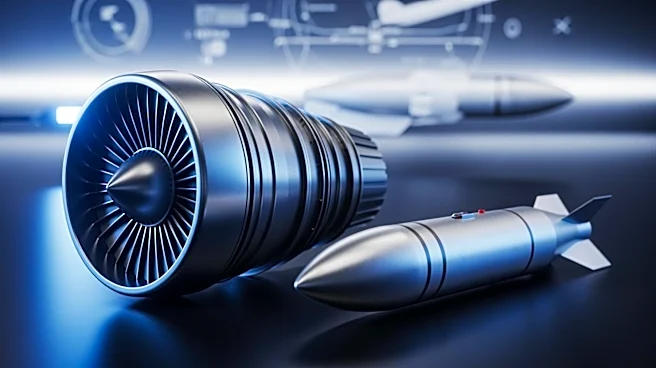
(JDAM) and can be launched from F/A-18 Super Hornet fighter jets. The tests, conducted off the coast of California, demonstrated the bomb's safe separation from the aircraft, integration with existing systems, and precision navigation over a distance of approximately 200 nautical miles. Unlike standard JDAMs, which are unpowered and rely on gravity, this variant is equipped with a small turbojet engine, effectively transforming it into a precision cruise missile. Boeing, the manufacturer, describes this development as a 'game-changing' improvement for precision strike missions, offering a range of over 300 nautical miles with a 500-pound warhead.
Why It's Important?
The development of the long-range JDAM is crucial as it provides the US military with a cost-effective alternative to traditional cruise missiles, which are significantly more expensive. This innovation allows for precision strikes from safer distances, enhancing the tactical advantage in contested environments. The affordability and extended range of this munition could lead to broader deployment across the Navy, addressing shortages in expensive standoff missiles. This capability is particularly important as the military seeks to maintain superiority in modern warfare, where the ability to strike from beyond enemy defenses is increasingly vital.
What's Next?
The next phase for the long-range JDAM involves shipboard integration, ensuring it can be effectively deployed from naval vessels. The Navy is committed to bringing this high-priority strike capability to the fleet, meeting the evolving demands of modern naval warfare. As the program progresses, further tests and evaluations will likely focus on refining the system's integration and operational effectiveness. The outcome of these developments could influence future procurement and deployment strategies within the US military.