





What's Happening?
Researchers from the Institute of Vertebrate Paleontology and Paleoanthropology (IVPP) of the Chinese Academy of Sciences have successfully identified the shared morphological features of Denisovans, an extinct group of hominins. This breakthrough was
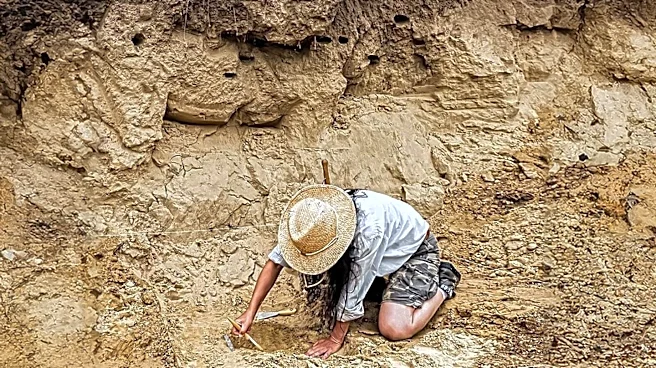
achieved by extracting ancient protein evidence from Xujiayao hominin fossils, confirming their Denisovan origin. Denisovans were previously identified primarily through DNA from a finger bone found in Siberia in 2010, but a lack of fossil records hindered understanding of their physical characteristics. The Xujiayao site in Hebei Province, dating back 199,000 to 138,000 years, provided an ideal location with abundant hominin fossils and reliable dating. By analyzing bone powder from damaged surfaces, the team used paleoproteomic analyses to confirm the Denisovan identity of these fossils. This allowed them to systematically summarize typical Denisovan features in the cranium, mandible, and teeth, noting both primitive traits similar to Homo erectus and advanced features seen in later Homo members.
Why It's Important?
This research is crucial for paleoanthropology as it provides the first comprehensive morphological description of Denisovans, moving beyond genetic identification to physical characteristics. The ability to recognize, compare, and classify Denisovans based on morphology will significantly advance the study of human evolution. It also suggests that other ancient hominins in East Asia during the Middle Pleistocene might also be Denisovans, potentially extending their known distribution across nearly the entire East Asian continent. This expansion of the Denisovan range challenges previous understandings of ancient human migration and interaction. The study's findings could lead to re-evaluations of existing fossil records and provide new insights into the interbreeding events between Denisovans and modern humans, a topic of growing interest in the field.
What's Next?
The systematic summary of Denisovan morphological features will enable researchers to re-examine other unidentified hominin fossils in East Asia and potentially confirm more Denisovan remains. This could lead to a more complete picture of Denisovan populations, their geographical spread, and their interactions with other hominin groups. Future research may focus on comparing these newly identified morphological traits with those of Neanderthals and early modern humans to better understand the evolutionary relationships and genetic exchanges between these groups. The methodology of using paleoproteomic analyses on damaged fossils could also be applied to other challenging archaeological sites, opening new avenues for identifying and characterizing ancient human populations where DNA preservation is poor.
Beyond the Headlines
The study highlights the power of paleoproteomics as a tool for understanding ancient human history, especially when DNA evidence is scarce. This approach offers a new lens through which to view the complex tapestry of human evolution, revealing the physical forms of groups previously known only through genetic traces. The discovery of Denisovan presence across a wider East Asian range underscores the dynamic and interconnected nature of ancient hominin populations, suggesting a more intricate pattern of migration, interaction, and interbreeding than previously imagined. This work contributes to a broader understanding of human diversity and adaptation in different environments over hundreds of thousands of years, challenging simplistic linear models of human origins.