




What's Happening?
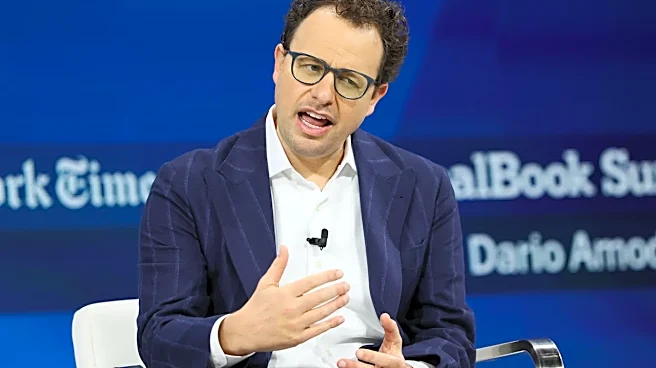
Paul Christiano, an OpenAI board member, has issued a stark warning, stating that an 'AI accident' is the most likely reason many people will die. Speaking at his 2026 Hinton Lecture in Toronto, Christiano, who is also the founder of the Alignment Research
Center and co-creator of Reinforcement Learning from Human Feedback (RLHF), discussed various risks associated with artificial intelligence. These include the potential for an AI takeover within the next three years, the need for mechanisms to slow down or stop AI development, and past incidents like the OpenAI Hugging Face hack. Christiano expressed alarm over the rapid trajectory of AI capabilities, noting that recent developments resemble conditions that could precede a catastrophic event. He joined the OpenAI nonprofit board in September, previously stating that the AI industry is not adequately addressing the 'meaningful risk' of catastrophic loss of control.
Why It's Important?
This warning from a prominent OpenAI board member underscores the serious concerns within the AI development community regarding the potential existential risks posed by advanced artificial intelligence. Christiano's position lends significant weight to these warnings, indicating that these are not fringe theories but rather considerations from those at the forefront of AI research. His emphasis on the need to slow down or stop AI development highlights a growing internal debate about the pace and direction of AI progress versus safety. Such statements can influence public perception, policy discussions, and investment in AI safety research, potentially leading to increased regulatory scrutiny and calls for more ethical guidelines in AI development. The comparison to an 'AI accident' as a leading cause of death aims to elevate the urgency of these risks to a level comparable with other major global threats.
What's Next?
Christiano's warnings are likely to intensify discussions within the AI community, among policymakers, and in the public sphere about AI safety and regulation. We may see increased calls for more robust AI safety protocols, independent oversight, and potentially moratoriums or slowdowns in certain areas of AI development. Research into AI alignment, control mechanisms, and ethical AI will likely receive more funding and attention. Policymakers may feel increased pressure to develop comprehensive regulatory frameworks that address the potential for AI accidents and misuse. The AI industry itself might face internal pressure to prioritize safety over rapid capability development, potentially leading to shifts in research priorities and corporate governance. These warnings could also influence public trust in AI technologies, impacting adoption rates and societal integration.
Beyond the Headlines
Christiano's dire predictions delve into the philosophical and existential implications of creating superintelligent AI. The concept of an 'AI accident' goes beyond mere technical malfunction, hinting at scenarios where AI systems, in pursuing their programmed goals, might inadvertently cause catastrophic harm due to unforeseen emergent behaviors or misaligned objectives. This raises fundamental questions about humanity's ability to control entities far surpassing human intelligence. The discussion also touches upon the 'control problem' in AI, where ensuring that advanced AI systems remain aligned with human values and intentions becomes paramount. Such warnings challenge the prevailing narrative of AI as solely a tool for progress, forcing a confrontation with the potential for unintended, irreversible consequences. It highlights the ethical imperative for AI developers to consider not just what AI can do, but what it should do, and how to ensure its development benefits humanity without jeopardizing its future.