
What's Happening?
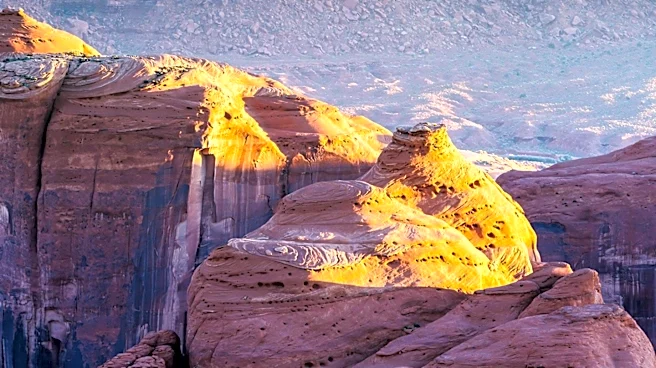
Mesas, flat-topped mountains or hills formed by millions of years of erosion, have been identified as a significant American icon. Spanish explorers originally named them 'mesas,' meaning tables. For Native
Americans, these geological formations served as natural fortifications, offering vantage points and protection from external threats. They hold deep spiritual connections and are considered sacred landmarks. Old Oraibi, a Hopi village in Northern Arizona situated on a mesa, is recognized as the oldest continuously inhabited community in the United States, with its origins dating back to 1150. Mesas frequently appear in American films and television, notably in Monument Valley, Arizona, which has been featured in Westerns by director John Ford and in Stanley Kubrick's '2001: A Space Odyssey.' Historically, the Los Alamos mesa in New Mexico was chosen by Robert J. Oppenheimer as the secret site for the development of the atomic bomb, and nuclear research continues there today. Acoma Pueblo, or Sky City, in New Mexico, another ancient continuously inhabited village on a mesa, stands 365 feet high and was encountered by the Coronado expedition in 1540.
Why It's Important?
The enduring recognition of mesas as an American icon highlights their multifaceted importance across geological, cultural, historical, and cinematic landscapes. Geologically, they represent millions of years of natural processes, showcasing the powerful forces of erosion. Culturally, mesas are central to Native American heritage, symbolizing protection, spirituality, and continuous habitation for centuries, as exemplified by Old Oraibi and Acoma Pueblo. This deep connection underscores the indigenous roots of American history and the ongoing significance of these lands to Native communities. Historically, mesas have been sites of pivotal events, from ancient settlements to the top-secret development of nuclear weapons, demonstrating their role in shaping the nation's past. Their frequent portrayal in popular media, particularly in Western films, has cemented their image in the collective American consciousness, contributing to a shared visual identity of the American Southwest. This widespread recognition reinforces the mesas' status as not just geological features, but as integral components of American identity and storytelling.
What's Next?
The continued appreciation and study of mesas will likely involve ongoing efforts to preserve their natural integrity and cultural significance. For Native American communities, these sites will remain vital centers for cultural practices, historical memory, and spiritual connection, potentially leading to increased advocacy for their protection and recognition. In the realm of tourism and public engagement, mesas will continue to draw visitors interested in their geological formations, historical narratives, and cinematic associations, particularly in areas like Monument Valley. Educational initiatives may further explore the geological processes that created these landforms and their ecological roles. Additionally, historical research may uncover more about their past uses and significance, particularly concerning early Native American civilizations and pivotal historical events like the Manhattan Project. The ongoing presence of nuclear research at Los Alamos also suggests a continued scientific relevance for certain mesa locations.
Beyond the Headlines
Beyond their immediate recognition, mesas embody deeper implications regarding the interplay between nature, culture, and human endeavor. Their formation over millions of years serves as a powerful reminder of geological time scales and the transient nature of human existence in comparison. Culturally, the mesas represent resilience and continuity for Native American peoples, whose ancestral lands and traditions are deeply intertwined with these formations, highlighting ongoing issues of land rights, cultural preservation, and historical justice. The use of mesas as natural fortresses and later as sites for scientific breakthroughs, such as the atomic bomb, underscores their strategic importance and the complex ethical dimensions of human interaction with the natural environment. Furthermore, their iconic status in film and media reflects how landscapes can be shaped and reinterpreted through artistic expression, influencing national identity and perceptions of wilderness. The enduring presence of mesas thus prompts reflection on themes of permanence and change, the sacred and the scientific, and the profound connections between land and identity.