

What's Happening?
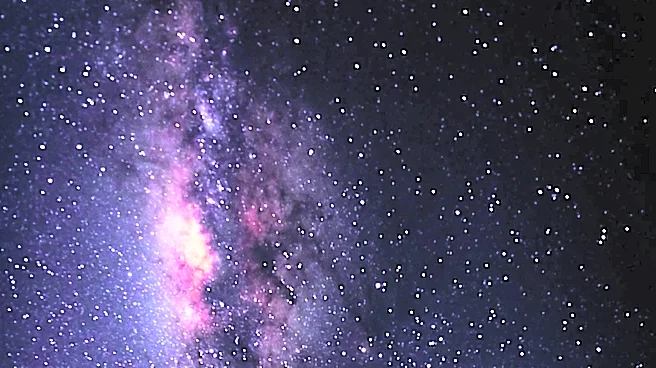
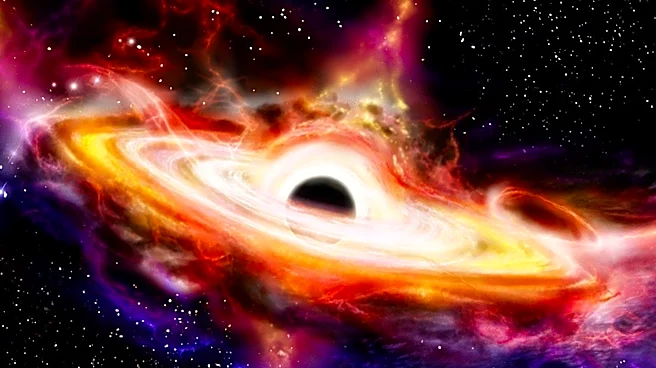
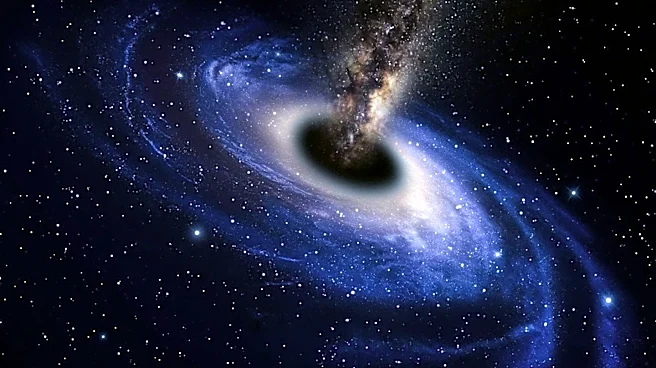
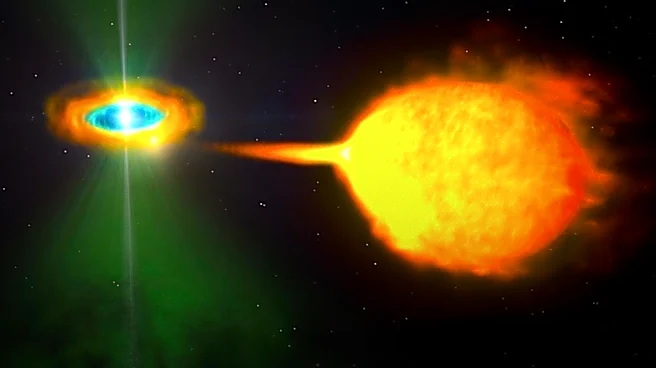
Recent simulations conducted by astronomers have estimated that the Milky Way contains approximately 170 million stellar-mass black holes. These black holes are remnants of massive stars that have exhausted their fusion fuel, leading to a collapse into
a dense object from which light cannot escape. The study, led by astrophysicist Tom Wagg of the Flatiron Institute, involved creating virtual models of the Milky Way to simulate billions of years of star formation, stellar deaths, and black hole births. The findings suggest that the distribution of these black holes is influenced by 'natal kicks' from supernova explosions, which propel them across the galaxy. The simulations indicate that lighter black holes tend to travel further from the galactic plane due to stronger kicks, while heavier ones remain closer. This research provides a roadmap for future surveys to study black hole masses and motions, offering insights into supernova explosions and black hole formation processes.
Why It's Important?
The study's findings have significant implications for our understanding of the Milky Way's structure and the lifecycle of stars. By estimating the number and distribution of black holes, astronomers can gain insights into the history of star formation and the dynamics of our galaxy. The research also highlights the role of supernova explosions in shaping the distribution of black holes, which could help refine models of stellar evolution. Understanding black hole distribution is crucial for future astronomical surveys, as it can reveal the processes behind supernova explosions and the formation of black holes. This knowledge could also aid in the development of more accurate simulations of galactic evolution, enhancing our comprehension of the universe's history.
What's Next?
Future astronomical surveys will aim to validate the predictions made by these simulations by observing the masses and motions of black holes. If the observations align with the simulations, it would confirm the models as effective tools for understanding galactic evolution. These surveys could also help distinguish between competing models of supernova explosions and black hole formation. As astronomers continue to explore the Milky Way's 'Galactic Underworld,' they may uncover new insights into the galaxy's past, potentially transforming our understanding of its history and evolution.