


What's Happening?
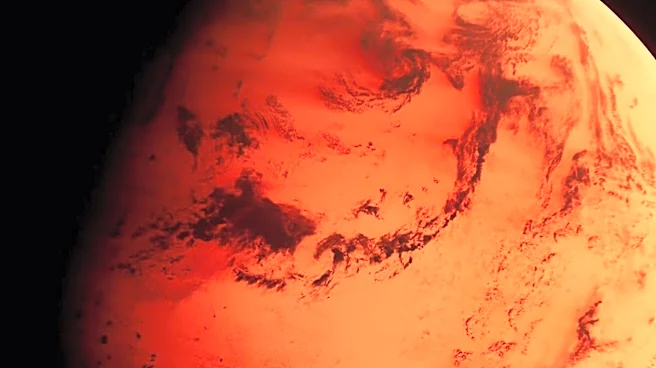
A recent simulation modeling the long-term effects of engineered aerosol warming on Mars has uncovered significant and previously unmodeled water cloud feedback. Researchers found that every 20 degrees of global warming in their simulation led to a tenfold
increase in atmospheric water vapor. This surge in water vapor resulted in the formation of clouds that had a dual effect on Martian temperatures. While these clouds warmed low-latitude nights by up to 10 degrees, they also caused a substantial cooling of daytime temperatures across the winter midlatitudes, by as much as 40 degrees. This unintended consequence was not accounted for in earlier dry-atmosphere models, which focused solely on the direct warming effects of aerosols without considering the planet's water cycle. The study utilized the three-dimensional MarsWRF global climate model, incorporating polar water ice sublimation, atmospheric transport, cloud formation, and subsequent ice deposition. The warming agent in the simulation was designed to mimic the optical properties of previously studied aluminum rods and graphene disks, producing significant warming per unit mass.
Why It's Important?
This discovery is crucial for understanding the complex atmospheric dynamics of Mars and has significant implications for any future terraforming or climate engineering proposals for the planet. Previous models that omitted the water cycle may have drastically underestimated the potential for localized cooling effects, which could counteract or complicate global warming efforts. The finding highlights that even a seemingly straightforward intervention like aerosol warming can trigger intricate feedback loops within a planetary climate system. The persistence of these water-related effects, even after the aerosol release is stopped, suggests that any climate modification on Mars could have long-lasting and potentially irreversible consequences. Understanding these feedbacks is vital for assessing the feasibility and safety of any large-scale planetary engineering projects, ensuring that unintended and detrimental outcomes are minimized or avoided.
What's Next?
Future research will likely focus on refining these climate models to incorporate more detailed cloud microphysics and interactions between engineered aerosols, natural dust, and cloud formation. The current model fixed cloud particles at a specific radius and omitted factors like particle clumping, re-lofting, degradation, and changes in surface brightness due to settled material. Addressing these uncertainties will provide a more accurate picture of the long-term climate response. Further studies will also need to explore the implications of these findings for potential human habitats or resource utilization on Mars, as significant temperature fluctuations could impact operational planning. Cross-model comparisons with other climate simulations will also be essential to validate these findings and identify any model-dependent biases, ultimately leading to a more robust understanding of Mars's atmospheric behavior under engineered warming scenarios.
Beyond the Headlines
The study underscores a broader scientific principle: complex systems often exhibit non-linear responses and unforeseen feedback mechanisms. In the context of planetary engineering, this means that even well-intentioned interventions can have cascading effects that are difficult to predict without comprehensive modeling. The discovery of localized cooling despite global warming efforts on Mars serves as a cautionary tale, emphasizing the need for thorough, multi-faceted research before attempting to alter planetary environments. It also highlights the interconnectedness of various planetary systems, where changes in one component, like atmospheric aerosols, can profoundly influence others, such as the water cycle and regional temperatures. This research contributes to the growing body of knowledge about planetary habitability and the delicate balance of extraterrestrial environments, informing not only future Mars missions but also our understanding of climate dynamics on Earth and beyond.