







What's Happening?
The value of cos 47 degrees is approximately 0.6820, a positive value because 47 degrees falls within Quadrant I of the unit circle. This specific trigonometric value is explored in detail, including its representation in radians (approximately 0.8203)
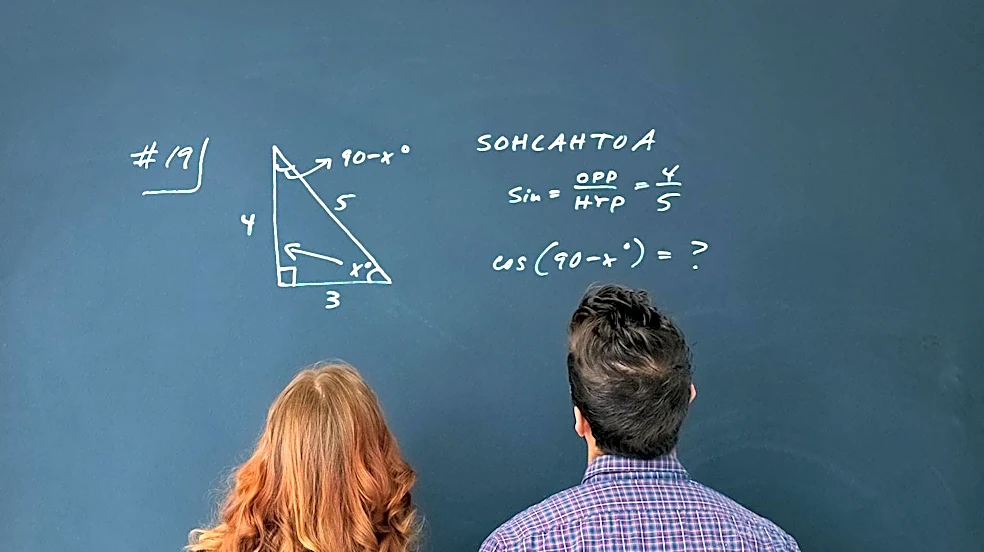
and its relationship to other trigonometric functions, such as sin 43 degrees, due to the co-function identity. The analysis highlights that cos 47 degrees does not possess a simple exact form involving whole numbers and real square roots, unlike angles that are multiples of 3 degrees. Various methods for calculating or approximating this value are discussed, including using a calculator in degree mode, reading from a unit circle, applying the Maclaurin series expansion, and using tangent line approximations from known angles like 45 degrees. The article also addresses common errors in calculating trigonometric values, such as incorrect co-function pairings, calculator mode settings (radians vs. degrees), and misapplication of small-angle formulas.
Why It's Important?
Understanding the calculation and properties of specific trigonometric values like cos 47 degrees is fundamental in various scientific and engineering disciplines. In fields such as surveying, navigation, and physics, these values are crucial for solving problems involving angles, distances, forces, and velocities. For instance, the horizontal component of a force or the 'run' of a ramp tilted at 47 degrees directly involves this cosine value. The discussion of approximation methods, such as the Maclaurin series and tangent line approximations, is vital for students and professionals who need to estimate values without a calculator or understand the underlying mathematical principles. Furthermore, recognizing common errors in trigonometric calculations helps prevent inaccuracies in practical applications, ensuring reliability in designs, measurements, and scientific models. This detailed breakdown serves as a foundational reference for both academic learning and real-world problem-solving.
What's Next?
The detailed explanation of cos 47 degrees serves as a comprehensive guide for students and educators in trigonometry. Future educational content or mathematical tools might build upon this foundation by integrating interactive simulations that demonstrate the unit circle, Maclaurin series, and various approximation techniques. Developers of scientific calculators and mathematical software could use this information to refine their algorithms for accuracy and efficiency, particularly for non-special angles. For individuals engaged in fields requiring precise angular measurements, such as architecture, civil engineering, or aerospace, this detailed understanding will continue to be applied in design and analysis. The emphasis on avoiding common errors suggests a continuous need for clear instructional materials and practice problems to reinforce correct calculation methods.
Beyond the Headlines
The exploration of cos 47 degrees extends beyond a mere numerical value, delving into the philosophical underpinnings of mathematical exactness versus approximation. The fact that certain angles, like 47 degrees, do not yield 'tidy exact values' in terms of simple surds highlights the inherent complexity of continuous functions and the limitations of algebraic representation. This distinction forces a reliance on numerical methods and approximations, which are cornerstones of computational mathematics and scientific modeling. The discussion of errors and their sources underscores the critical importance of precision and verification in all quantitative fields. It implicitly touches upon the ethical responsibility of practitioners to understand the limitations of their tools and methods. Moreover, the interconnectedness of trigonometric functions through identities, such as the co-function identity, reveals the elegant structure and internal consistency of mathematics, providing a deeper appreciation for its logical framework.