





What's Happening?
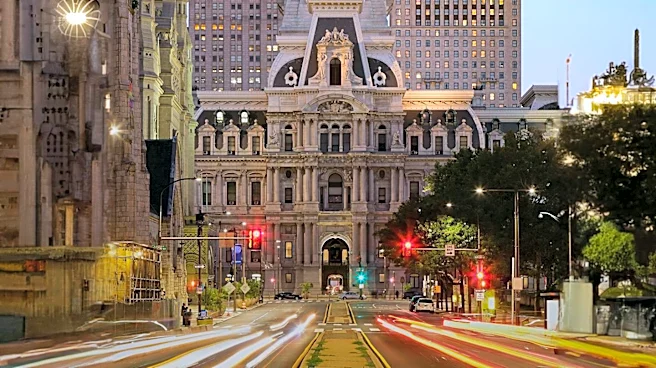
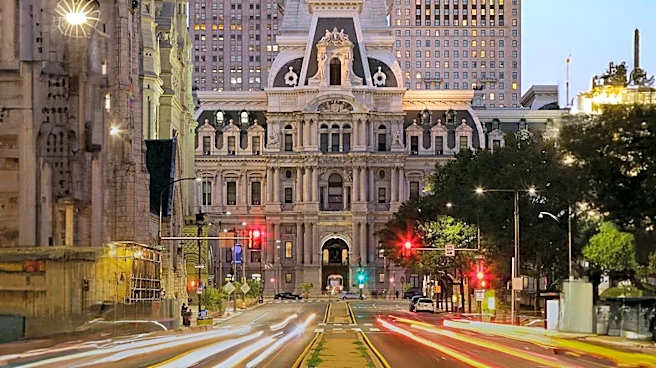
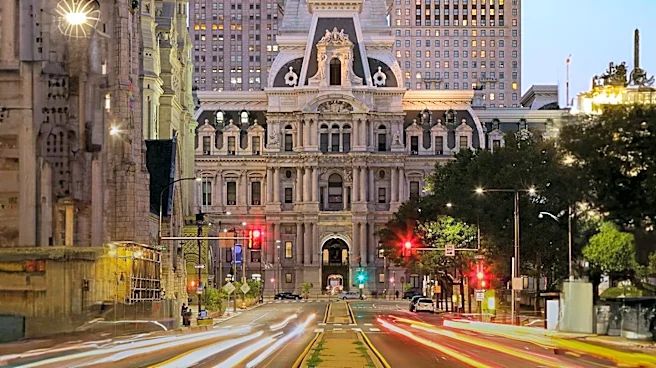
Philadelphia Mayor Cherelle Parker announced that 'The Portal,' an audio-less livestream camera connecting Philadelphia to other global cities, will remain at City Hall. This decision comes after organizers had initially planned to move the structure
at the end of the month, following its two-year tenure in the city. Mayor Parker made an unscheduled appearance at The Portal, emphasizing its significance as a symbol of global connection. She stated that keeping The Portal in Philadelphia would require private-public partnerships, acknowledging that the city could not achieve this alone. Shortly after her announcement, the Mayor's office confirmed that The Portal would stay, partly due to support from a 'generous patron,' though efforts for long-term funding are ongoing. The Portal, installed in 2024 as part of America250 celebrations, has served as a virtual window to several European cities, fostering human connection.
Why It's Important?
The decision to keep 'The Portal' in Philadelphia is important for several reasons. It reinforces Philadelphia's commitment to global engagement and cultural exchange, positioning the city as a hub for international connection. For residents, The Portal offers a unique opportunity to interact with people from different parts of the world, fostering a sense of global community and understanding. Economically, its continued presence could enhance Philadelphia's image as a forward-thinking and culturally rich city, potentially attracting tourism and international partnerships. The reliance on private-public partnerships for its retention also highlights a model for funding public art and cultural initiatives, demonstrating how community and private sector support can preserve valuable urban installations. This initiative underscores the value placed on accessible public art and technology in urban spaces.
What's Next?
Following Mayor Parker's announcement, the immediate next step is to secure long-term funding for 'The Portal' through ongoing private-public partnerships. While a generous patron has ensured its immediate stay, sustained financial support will be crucial for its continued operation and maintenance. The city and its partners will likely explore various funding models, including corporate sponsorships, grants, and community fundraising initiatives. There may also be discussions about expanding The Portal's reach to connect with more cities globally, further enhancing its mission of fostering human connection. The success of these efforts will determine the longevity and future evolution of this unique public art installation in Philadelphia.
Beyond the Headlines
The retention of 'The Portal' in Philadelphia delves deeper than just a public art installation; it touches upon the evolving role of technology in fostering global citizenship and empathy. In an increasingly interconnected yet often polarized world, initiatives like The Portal offer a tangible, albeit virtual, space for people to experience shared humanity. It challenges traditional notions of borders and distances, promoting a sense of collective identity. The ethical implications of such technology, including privacy and representation, are also subtle considerations. Furthermore, it highlights the power of public spaces to host innovative projects that transcend local boundaries, encouraging dialogue and understanding on a global scale. This project serves as a testament to how cities can leverage technology to build bridges between cultures.