
What's Happening?
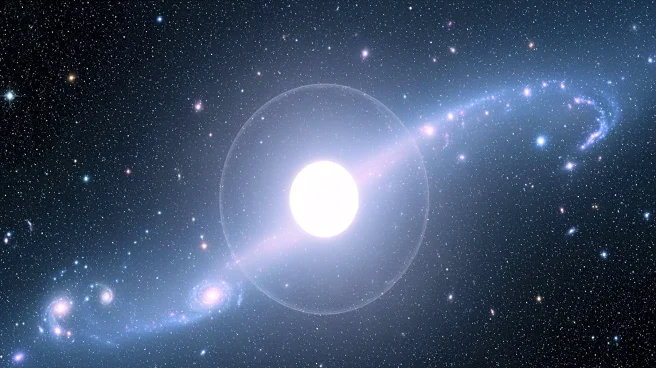
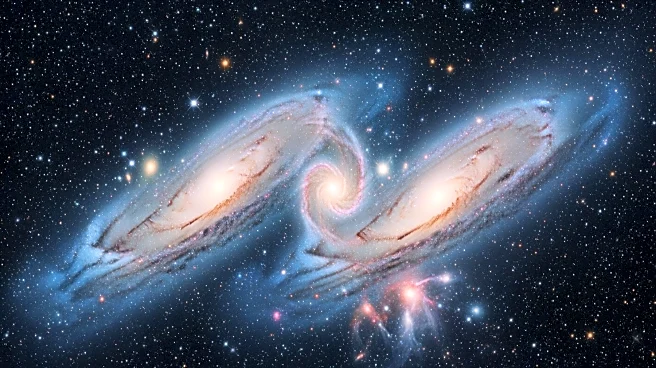
Astronomers have identified the most distant and brightest 'space laser,' known as a megamaser, emanating from a collision between galaxies. This event occurred when the universe was approximately half its current age. The galaxy system, designated HATLAS
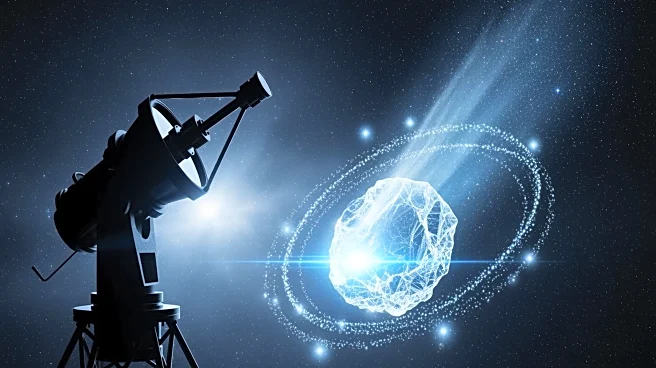
J142935.3–002836, is emitting light that has traveled for about 8 billion years before reaching the MeerKAT radio telescope in South Africa. The megamaser is a hydroxyl type, created when hydroxyl molecules collide within the dense gas of merging galaxies. Gravitational lensing, a phenomenon predicted by Albert Einstein, has magnified the signal, making it detectable despite its distance. This discovery provides insights into the conditions of the early universe and the processes driving star formation.
Why It's Important?
The discovery of this distant megamaser is significant as it offers a glimpse into the early universe, helping astronomers understand galaxy evolution and star formation processes. Megamasers are rare and typically found in bright infrared galaxies with large amounts of gas and dust, often resulting from galaxy mergers. These environments can trigger intense star formation and create conditions for hydroxyl molecules to amplify radio emissions. Studying these emissions can reveal information about gas kinematics and physical conditions in galaxies. Additionally, megamasers can indicate the presence of dual active galactic nuclei or pairs of supermassive black holes, which are expected to produce gravitational waves, furthering our understanding of cosmic phenomena.
What's Next?
Future research will focus on understanding how common megamasers were in the early universe and their relationship to galaxy evolution and star formation. By analyzing emission lines, scientists can learn more about the processes driving star formation and the conditions within these distant galaxies. The study of megamasers may also provide insights into the presence of dual active galactic nuclei, potentially leading to discoveries related to gravitational waves. Continued observations using advanced telescopes and techniques will enhance our knowledge of the universe's history and the dynamics of galaxy mergers.
Beyond the Headlines
The discovery of this megamaser highlights the importance of gravitational lensing as a tool for observing distant cosmic events. This natural magnification allows astronomers to study systems that would otherwise be too faint to detect, offering a unique perspective on the universe's evolution. The presence of hydroxyl megamasers in merging galaxies suggests intense molecular activity, which could have implications for understanding the formation of stars and galaxies. Additionally, the study of megamasers may contribute to the search for gravitational waves, providing a deeper understanding of the universe's fundamental forces.