


What's Happening?
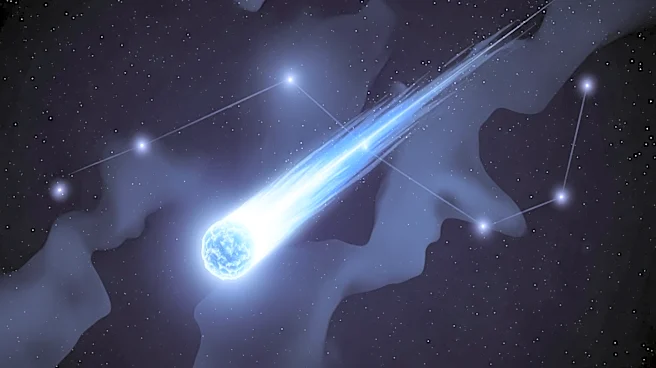
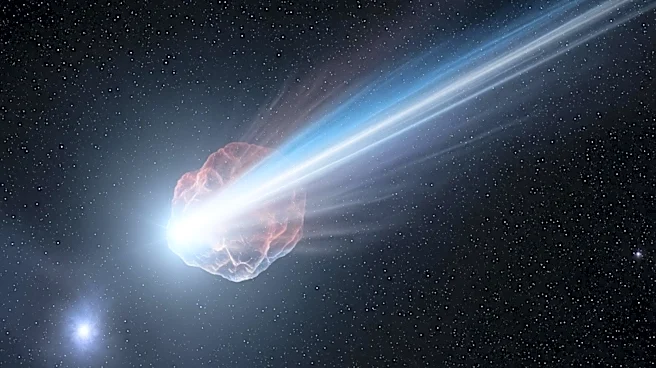
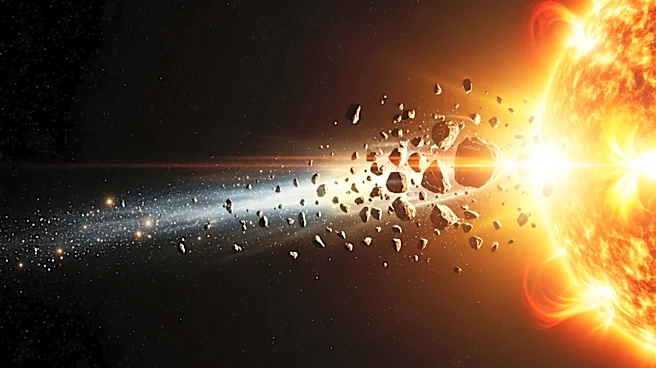
Comet C/2025 R3 (Pan-STARRS), discovered by the Pan-STARRS survey in Hawaii, is making a rare appearance in the inner solar system, an event that occurs only once every 170,000 years. Currently visible from the Northern Hemisphere, the comet is expected
to brighten dramatically as it approaches perihelion in mid-to-late April, potentially reaching magnitude +3, making it visible without optical aid under good conditions. However, as the comet brightens, it sinks lower on the eastern horizon, making observation challenging due to twilight interference. Astronomers recommend viewing the comet in the early morning hours with an unobstructed view of the eastern horizon. The comet's unpredictable nature adds to the excitement, as its behavior can vary significantly due to the physics of outgassing.
Why It's Important?
The appearance of Comet C/2025 R3 (Pan-STARRS) offers a unique opportunity for astronomers and enthusiasts to observe a celestial event that occurs once per geological epoch. This long-period comet's visit provides insights into the dynamics of cometary behavior and the solar system's history. The event underscores the importance of astronomical observations in understanding the universe's vastness and the solar system's dynamic nature. For the scientific community, it presents a chance to study the comet's composition and behavior, contributing to the broader knowledge of cometary physics and the solar system's evolution.
What's Next?
As Comet C/2025 R3 (Pan-STARRS) approaches perihelion, observers in the Southern Hemisphere will have better viewing conditions as the comet moves away from the sun in their skies. The comet will become a Southern Hemisphere prize, offering a clearer view as it fades gradually. For Northern Hemisphere observers, the window to view the comet is closing, with optimal conditions expected in mid-April. After perihelion, the comet will move out of view, not to return for another 170,000 years, emphasizing the fleeting nature of this astronomical event.
Beyond the Headlines
The appearance of Comet C/2025 R3 (Pan-STARRS) highlights the unpredictable nature of comets, which can defy expectations in terms of brightness and visibility. This unpredictability is due to the complex physics of outgassing, where solar heating sublimates ices inside the comet's nucleus, affecting its visibility and behavior. The event also serves as a reminder of the solar system's dynamic nature, with objects on long orbits that make human history seem brief in comparison. Observing such a rare event connects humanity to the broader cosmic timeline, offering a moment of reflection on our place in the universe.