







What's Happening?
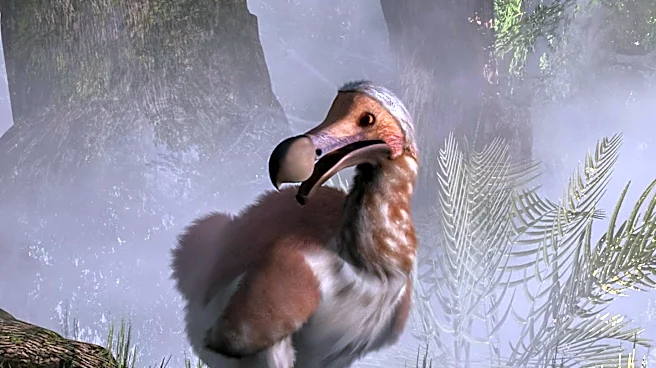
Researchers in Taiwan have recreated a dinosaur nest to study the incubation methods of oviraptors, a group of feathered, bird-like dinosaurs from the Late Cretaceous Period. The study, published in Frontiers in Ecology and Evolution, involved building
a life-sized model of an oviraptor and its nest using artificial eggs. The research aimed to determine whether oviraptors incubated their eggs like modern birds or relied on environmental heat. The findings suggest that the position of the brooding adult relative to the eggs was crucial for their development. The study also found that oviraptor incubation was less efficient than that of modern birds, indicating a different evolutionary path in nesting behaviors.
Why It's Important?
This research provides new insights into the evolutionary transition from non-avian dinosaurs to modern birds. By understanding the nesting and incubation behaviors of oviraptors, scientists can better comprehend how certain traits associated with birds evolved long before the first true birds appeared. The study highlights the importance of environmental factors in the incubation process, suggesting that oviraptors may have used a combination of adult incubation and ambient heat sources. This research not only sheds light on dinosaur parenting but also offers a novel approach to studying dinosaur reproduction, combining physical reconstructions with heat transfer modeling.