
What's Happening?
The European Maritime Safety Agency (EMSA) has awarded a €30 million framework contract to Airbus for the provision of maritime surveillance services using the Flexrotor Uncrewed Aerial System (UAS). This
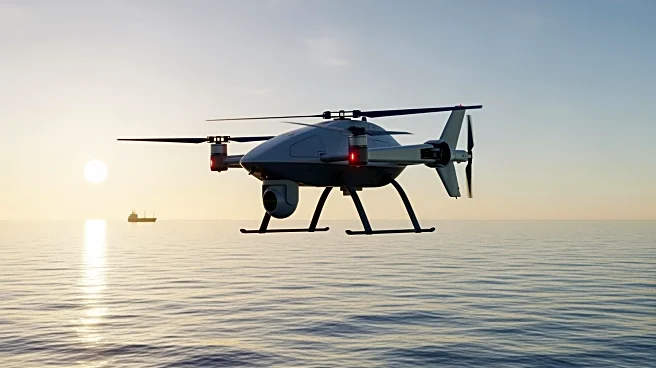
contract marks the first operational deployment of the Flexrotor in Europe, aimed at extending coastal range and enhancing long-endurance capabilities to support national authorities in EU Member States, Norway, and Iceland. The Flexrotor, a Vertical Takeoff and Landing (VTOL) uncrewed aircraft, is designed for Intelligence, Surveillance, Target Acquisition, and Reconnaissance (ISTAR) missions. It can maintain endurance for over 12 to 14 hours in a typical configuration, though it is rated for 10 hours in the EMSA configuration. The system is capable of autonomous launch and recovery from a minimal footprint area on land or sea. The contract includes the delivery of Electro-Optical/Infrared (EO/IR) and radar imagery, streamed directly to the EMSA RPAS Data Centre for real-time monitoring by national authorities.
Why It's Important?
This development is significant as it enhances maritime surveillance capabilities across Europe, providing critical support for Coast Guard operations such as search and rescue, fisheries control, and environmental protection. The deployment of the Flexrotor UAS is expected to improve the detection of illicit maritime activities, thereby strengthening maritime security. The contract also represents a strategic advancement in the use of uncrewed systems for national security and environmental monitoring, showcasing the potential for such technologies to offer reliable, high-performance solutions for complex mission profiles. The partnership between EMSA and Airbus underscores the growing importance of integrating advanced UAS technologies into maritime operations, potentially setting a precedent for similar initiatives globally.
What's Next?
The initial agreement spans two years, with options to extend up to four years, and service is scheduled to commence in 2026. As the Flexrotor begins operational flights, it is anticipated that its performance will be closely monitored to assess its effectiveness in enhancing maritime surveillance. The flexibility of the framework allows for additional operations to be added as required, suggesting that the scope of the project could expand based on initial outcomes. Stakeholders, including national authorities and maritime agencies, will likely evaluate the impact of this technology on their operations, potentially influencing future investments in similar UAS technologies.