
What's Happening?
A recent study highlights the fragility of satellite operations in low Earth orbit, suggesting that a loss of control over satellites could lead to a major collision in as little as 2.8 days. The study,
led by Sarah Thiele from Princeton University, introduces the Collision Realization And Significant Harm (CRASH) Clock, which estimates the time frame for potential collisions under degraded conditions. The research indicates that the increasing density of satellites and debris has significantly reduced the time window for avoiding collisions, from 164 days in 2018 to just a few days now. The study also emphasizes the risk posed by solar storms, which can disrupt satellite tracking and communication, further increasing the likelihood of collisions.
Why It's Important?
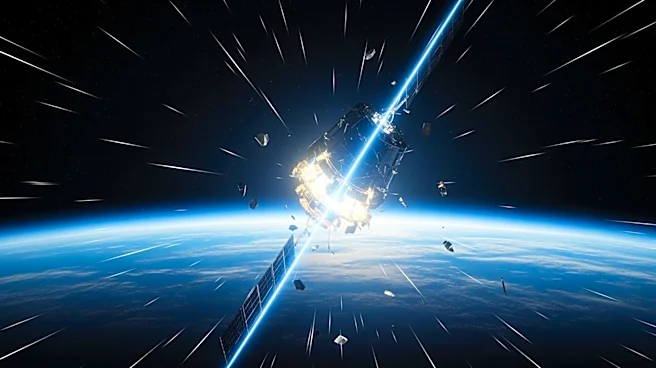
The findings underscore the growing risks associated with the increasing number of satellites in low Earth orbit, particularly with the rise of mega-constellations like Starlink. These networks, while providing global internet coverage, also contribute to congestion in space, making it more challenging to manage and avoid collisions. A major collision could generate thousands of debris fragments, leading to a cascade of further collisions, known as the Kessler Syndrome, which could render parts of space unusable. This scenario poses significant risks to global communications, navigation, and weather forecasting systems that rely on satellite infrastructure.
What's Next?
The study suggests that improving satellite tracking and communication systems is crucial to prevent potential collisions. Additionally, there is a need for international cooperation to manage the increasing congestion in low Earth orbit. Future research may focus on developing more robust systems to withstand solar storms and other disruptions. Policymakers and space agencies might also consider regulations to limit the number of satellites launched and to ensure that existing satellites can be safely deorbited at the end of their operational life.