






What's Happening?
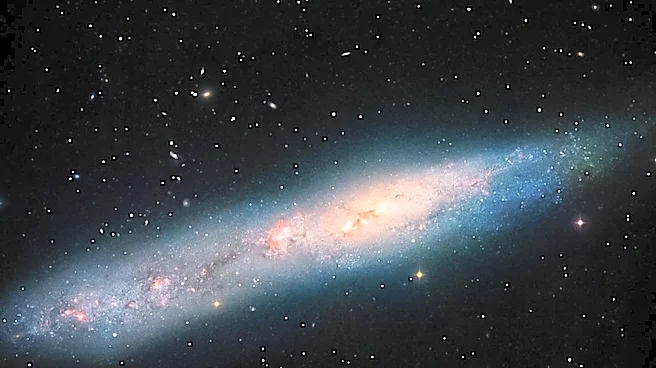
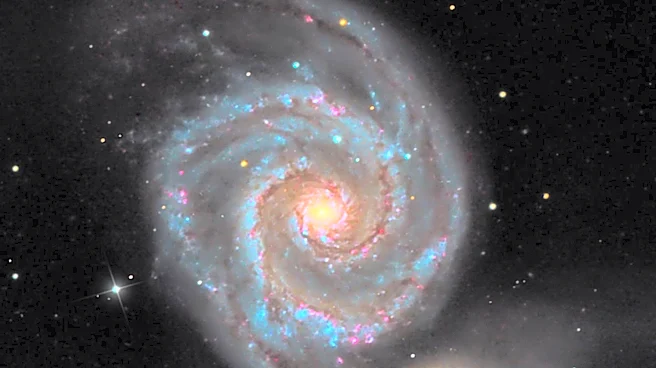
The Hubble Space Telescope has captured an image of the spiral galaxy NGC 4654, located 72 million light-years away in the Virgo Cluster. This galaxy exhibits a unique asymmetry, with a rounded edge on one side and a gaseous tail on the other, caused
by ram pressure stripping as it moves through the cluster. The galaxy's uneven star distribution is attributed to a past gravitational interaction with another galaxy, NGC 4639, which affected its shape and star formation.
Why It's Important?
The observation of NGC 4654 provides valuable insights into the dynamics of galaxy interactions and the effects of ram pressure stripping. Understanding these processes is crucial for astronomers studying galaxy evolution and the role of environmental factors in shaping galactic structures. The data from Hubble contributes to ongoing research on star formation and gas movement within galaxies, enhancing our knowledge of the universe. This discovery underscores the importance of space telescopes in advancing astronomical research and expanding our understanding of cosmic phenomena.