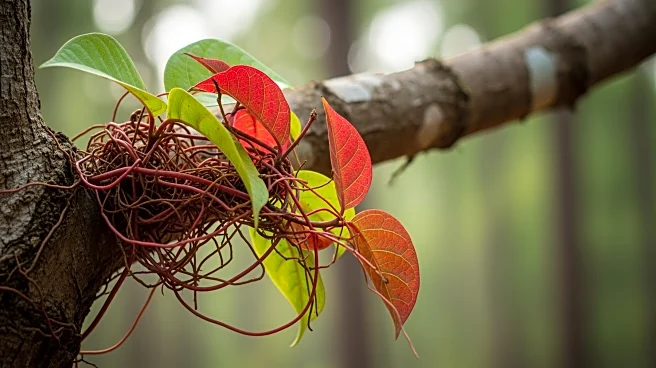

What's Happening?
Researchers from the Okinawa Institute of Science and Technology, Kobe University, and the University of Taipei have conducted a study on Balanophora, a rare parasitic plant often mistaken for a mushroom.
Found in the forests of Taiwan, Japan, and Okinawa, Balanophora lacks chlorophyll and survives by attaching to tree roots. The study, published in New Phytologist, explores the plant's evolutionary history and its unique reproductive strategies, including facultative and obligate agamospermy. Despite its parasitic nature, Balanophora retains plastids, albeit reduced, which play a crucial role in its survival. The plant's dependence on specific tree species and its limited habitats make it vulnerable to environmental changes.
Why It's Important?
The study of Balanophora provides significant insights into plant evolution, particularly in understanding how parasitic plants adapt and survive. The findings highlight the plant's unique reproductive strategies, which could inform conservation efforts for other rare species. Balanophora's vulnerability due to habitat specificity underscores the importance of protecting its environment from human activities like logging. This research contributes to broader ecological knowledge and emphasizes the need for preserving biodiversity, especially in regions facing environmental threats.
What's Next?
Future research may focus on further understanding Balanophora's reproductive mechanisms and its interactions with host trees. Conservation efforts are crucial to protect its habitats, particularly in Okinawa, where human activities pose a threat. Collaboration with local authorities and continued study of this plant could lead to strategies that mitigate extinction risks. The research team aims to explore more about the plant's plastid functions and its evolutionary path, which could offer broader implications for studying other parasitic species.