






What's Happening?
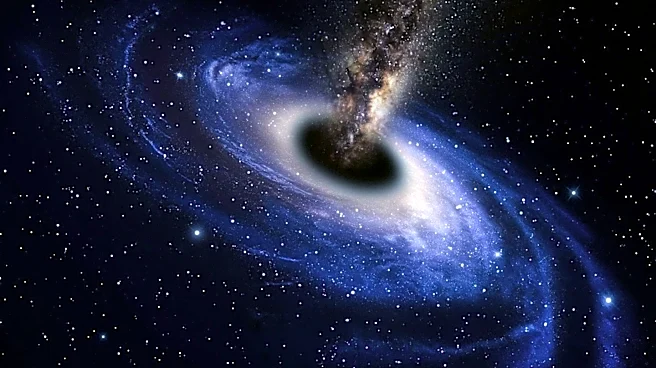
A new theoretical study, 'When Black Holes Admit Pair-of-pants Topologies,' published in the journal Physical Review D, investigates the possibility of a single black hole splitting into two smaller ones. Traditionally, black holes do not split due to thermodynamic
reasons; splitting an ordinary, non-rotating black hole would reduce its total entropy, making the process thermodynamically unfavorable. However, calculations by a team including Francesco Sannino, a professor of physics at the University of Naples Federico II and the Quantum Field Theory Center at the University of Southern Denmark, suggest that rapidly rotating black holes could provide a loophole for this to occur. The study also explores more exotic possibilities, such as those involving additional dimensions of space, where black-hole-like objects might become unstable and break apart. If a split were to happen, the black hole's outer boundary, known as the horizon, would form a 'pants-like shape' through time, with one section dividing into two 'legs.'
Why It's Important?
This research challenges conventional understanding of black hole thermodynamics and could significantly impact theoretical physics and astrophysics. If black holes can indeed split, especially those rotating at near-maximum rates, it would open new avenues for understanding the life cycles of these cosmic phenomena. The concept of 'pair-of-pants topologies' offers a novel way to visualize and model such events, potentially leading to new mathematical frameworks for describing spacetime. Furthermore, the exploration of splitting in theories involving extra dimensions could provide insights into fundamental physics beyond Einstein's theory of gravity. This theoretical work could guide future observational efforts, as scientists might indirectly detect such splits through gamma-ray telescopes searching for signals from tiny black-hole fragments, particularly from primordial black holes, which are hypothesized to be more prone to splitting than larger astrophysical ones.
What's Next?
The research team is continuing to quantify the conditions under which black hole splitting could occur, particularly how gravity behaves beyond Einstein's theory. They anticipate that small primordial black holes might be more susceptible to splitting than larger astrophysical black holes. Future work will involve refining these calculations and exploring the implications for various theoretical models. Indirect detection of black hole splitting remains a key area of interest, with gamma-ray telescopes like Fermi-LAT potentially playing a role in searching for evidence of tiny black-hole fragments that might form during such events. The study's findings could also stimulate further theoretical investigations into the role of entropy in rapidly rotating black holes and the potential for fragmentation in different cosmological scenarios.
Beyond the Headlines
The theoretical possibility of black holes splitting has profound implications for our understanding of the universe's most extreme objects. It challenges the long-held assumption that black holes only merge, introducing a new dynamic to their evolution. This concept could influence theories about the early universe, particularly regarding the formation and distribution of primordial black holes. The 'pair-of-pants topologies' metaphor not only provides a vivid image but also suggests a complex topological evolution of spacetime around these objects. Moreover, the study's venture into additional dimensions highlights the ongoing quest to unify different physical theories and explore the boundaries of known physics. The potential for indirect detection through gamma-ray observations underscores the interplay between theoretical predictions and observational astronomy, pushing the limits of what can be observed and understood about the cosmos.