



What's Happening?
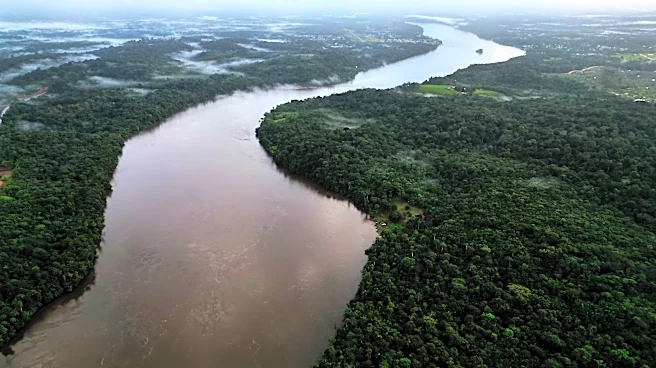
Researchers have uncovered thousands of ancient structures in the southwestern Amazon using Lidar technology, revealing the existence of the Aquiry civilization. This discovery, published in the journal Nature, was made possible by airborne Lidar, which
can penetrate dense rainforest canopies to map the Earth's surface. The study, conducted by Finnish and Brazilian scientists, suggests that between 1.25 and 3 million people lived in this region during the first centuries AD. The Lidar mapping campaign covered over 4,400 kilometers in Brazil's Acre state, identifying 347 earthworks within a 2,380 square kilometer area. The findings indicate that the Aquiry civilization's territory may have spanned approximately 183,000 square kilometers, significantly larger than previously estimated. The structures, primarily geometric enclosures, are believed to have served ceremonial or public functions, highlighting the complexity and organizational capabilities of this ancient society.
Why It's Important?
The discovery of the Aquiry civilization's structures has significant implications for our understanding of precolonial societies in the Amazon. It challenges previous assumptions about the region's historical population density and societal complexity. The findings suggest that the Amazon was home to a sophisticated civilization capable of large-scale construction and organized labor. This revelation could reshape archaeological perspectives on the development of human societies in rainforest environments. Additionally, the use of Lidar technology demonstrates its transformative impact on archaeology, enabling researchers to uncover hidden historical landscapes that were previously inaccessible. This advancement could lead to further discoveries in other densely forested regions, offering new insights into ancient civilizations worldwide.
What's Next?
Further research is needed to confirm the full extent of the Aquiry civilization and to understand the specific functions of the discovered structures. Ground-based fieldwork will be essential to verify the Lidar data and to explore the cultural and historical context of these earthworks. Researchers plan to continue using Lidar technology to map additional areas of the Amazon, potentially uncovering more about the Aquiry civilization and other unknown societies. This ongoing exploration could provide a more comprehensive understanding of the region's precolonial history and its impact on contemporary Amazonian cultures.
Beyond the Headlines
The discovery raises questions about the environmental impact of ancient civilizations on the Amazon rainforest. Understanding how the Aquiry civilization managed resources and interacted with their environment could offer valuable lessons for modern conservation efforts. Additionally, the findings highlight the importance of preserving archaeological sites in the Amazon, which are threatened by deforestation and development. Protecting these sites is crucial for maintaining the cultural heritage and historical knowledge of the region.