
What's Happening?
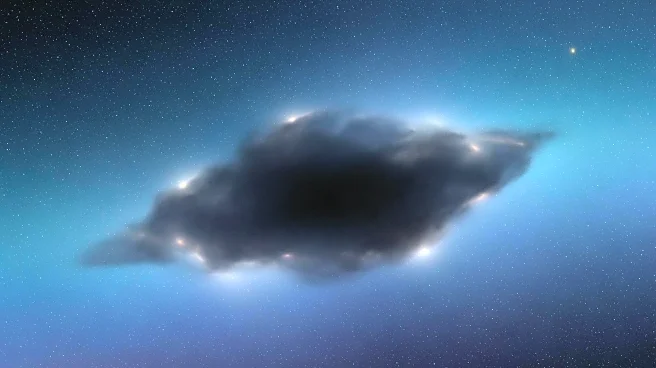
NASA has announced the discovery of a starless galaxy, named Cloud-9, during a press conference at the American Astronomical Society meeting in Phoenix. The discovery was shared by Rachael Beaton, a member
of the COPAG Executive Committee. Cloud-9 was initially identified using radio telescopes, and subsequent observations with the Hubble Space Telescope confirmed the absence of stars, despite the presence of radio-emitting gas. This type of galaxy, primarily composed of dark matter, has been theorized for some time but had not been observed until now. The findings have been published in the Astrophysical Journal Letters.
Why It's Important?
The discovery of Cloud-9 is significant as it provides evidence for the existence of starless galaxies, which have been a theoretical concept in astronomy. This finding could enhance the understanding of dark matter, a mysterious substance that makes up a significant portion of the universe's mass. By studying such galaxies, scientists can gain insights into the formation and evolution of galaxies and the role of dark matter in these processes. This discovery may also prompt further research into similar objects, potentially leading to new breakthroughs in astrophysics.
What's Next?
Following the discovery of Cloud-9, astronomers may conduct additional observations to identify more starless galaxies and study their properties. This could involve using advanced telescopes and instruments to detect other galaxies with similar characteristics. The research community may also explore the implications of these findings on existing models of galaxy formation and the distribution of dark matter in the universe. Collaborative efforts between international space agencies and research institutions could be initiated to further investigate these phenomena.
Beyond the Headlines
The identification of a starless galaxy like Cloud-9 challenges existing astronomical models and could lead to a reevaluation of how galaxies are classified and understood. It raises questions about the lifecycle of galaxies and the potential for other 'abandoned' galaxies in the universe. This discovery also highlights the importance of technological advancements in telescopes and observational techniques, which enable scientists to explore previously unobservable aspects of the cosmos.