




What's Happening?
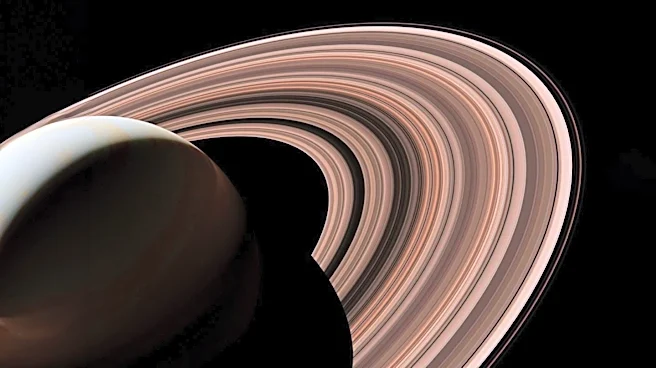
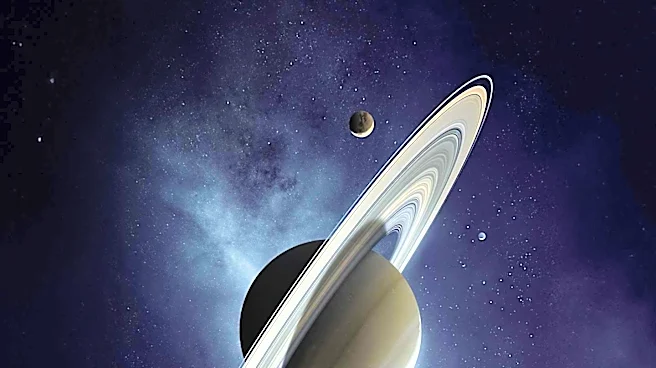
Titan, Saturn's largest moon, exhibits tidal locking, where its rotation period matches its orbital period, causing one hemisphere to always face Saturn. This phenomenon results in a unique sky where Saturn is permanently visible from one side of Titan and
never seen from the other. Tidal locking is common in the solar system and is expected for many exoplanets orbiting red dwarf stars. This locking can lead to planets with one hemisphere in perpetual daylight and the other in constant night, contrasting with Earth's dynamic sky.
Why It's Important?
Understanding tidal locking on Titan provides valuable insights into planetary dynamics and the potential habitability of exoplanets. As many exoplanets orbit red dwarf stars, tidal locking could be a common feature, affecting climate and atmospheric conditions. This knowledge is crucial for astronomers and astrobiologists studying the potential for life on other planets. The study of Titan's rotation and its effects also enhances our understanding of the solar system's moons and their interactions with their parent planets.
Beyond the Headlines
The study of Titan's tidal locking extends beyond mere curiosity, offering a window into the moon's interior and geological activity. Observations from the Cassini mission suggest the presence of a subsurface ocean or a deformable ice layer, which could have implications for understanding Titan's potential for hosting life. Additionally, the phenomenon of tidal locking on exoplanets could influence future space exploration missions and the search for habitable worlds beyond our solar system.