







What's Happening?
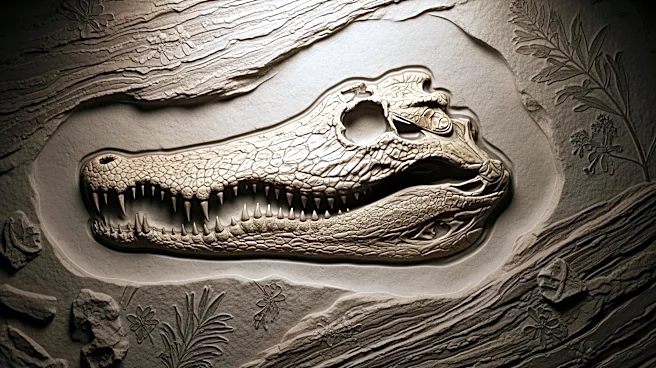
A team of Yale paleontologists has identified a new species of crocodile cousin, Eosphorosuchus lacrimosa, from fossils dating back 210 million years. The discovery was made at Ghost Ranch, New Mexico, where the remains of two crocodile cousins were found
preserved together. The newly identified species had a shorter snout and reinforced skull, suggesting it was adapted to crush larger prey. This finding highlights the diversification of proto-crocodiles during the late Triassic period, a time when reptiles were vying for dominance. The research, led by Bhart-Anjan Bhullar and Miranda Margulis-Ohnuma, was published in the journal Proceedings of the Royal Society B.
Why It's Important?
The discovery of Eosphorosuchus lacrimosa provides significant insights into the evolutionary history of crocodiles and their relatives. It illustrates the early diversification of crocodylomorphs, the group that would eventually lead to modern crocodiles. This finding enriches our understanding of the ecological dynamics during the late Triassic period, a critical time in the evolution of reptiles. The research underscores the importance of well-preserved fossil sites like Ghost Ranch in reconstructing ancient ecosystems and understanding the evolutionary pathways of major reptilian lineages.