


What's Happening?
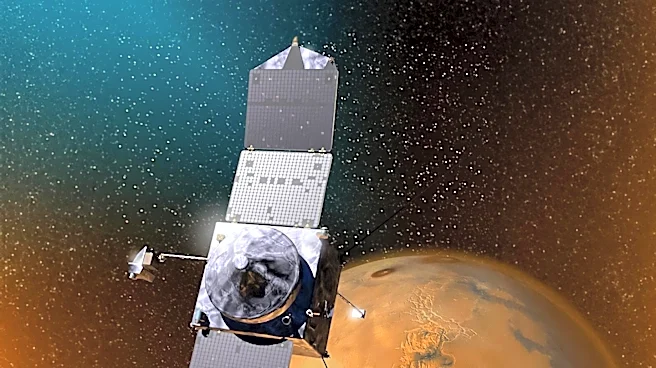
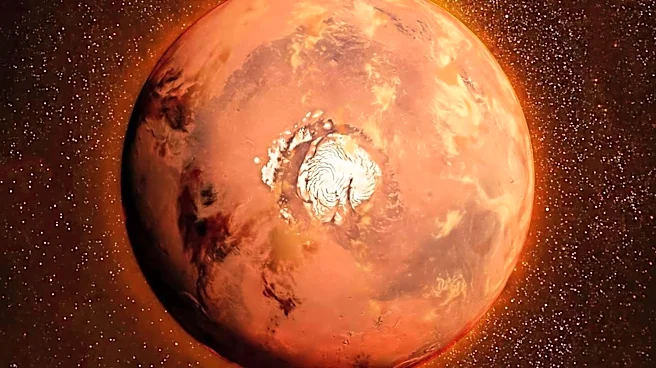
An international team of researchers, utilizing data from the European and Russian ExoMars Trace Gas Orbiter collected in 2021, has found evidence suggesting recent volcanic activity on Mars. The orbiter detected hydrogen chloride gas emissions, which
scientists believe are being released from hot magma deep beneath the Martian surface. This discovery is supported by the identification of intriguing new fissures, thousands of feet in length, along the flanks of Alba Mons, the largest volcano on Mars by surface area. These fissures exhibit discolorations, which researchers hypothesize are mineral deposits left by seeping gases, similar to volcanic gas vents on Earth. This research challenges the long-held belief that Mars is geologically dead, indicating it may have retained enough internal heat to support volcanic activity until recently, and possibly still does. The findings were detailed in a new paper published in the journal Science Advances.
Why It's Important?
This discovery has significant implications for the understanding of Mars' geological history and the potential for ancient life on the Red Planet. If Mars was recently volcanically active, it suggests a warmer and thicker atmosphere in its past, which could have supported the presence of liquid water on its surface—a key ingredient for life. The existence of hydrothermal systems within these fissures could provide the necessary ingredients and energy for microorganisms to develop, while also shielding them from the harsh surface environment. This makes these newly identified fissures prime locations for future missions to search for evidence of past Martian life. For the U.S. space program, particularly NASA's Mars exploration initiatives, these findings could influence the targeting of future rovers and landers, shifting focus to areas with potential hydrothermal activity. It also contributes to the broader scientific understanding of planetary evolution and the conditions necessary for life beyond Earth.
What's Next?
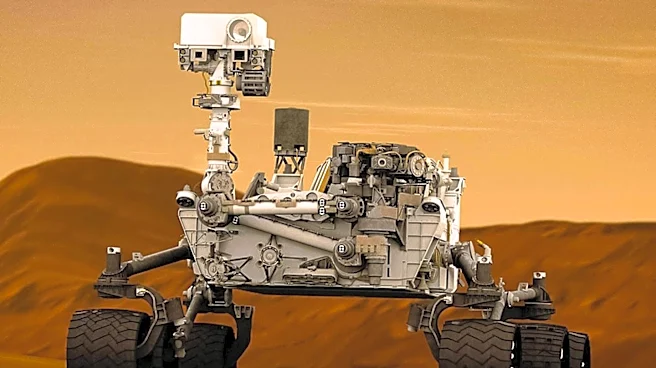
The findings will likely spur further research and analysis of existing and future data from Mars orbiters and landers. Scientists will aim to confirm the ongoing nature of this volcanic activity and better understand the mechanisms driving the hydrogen chloride emissions. Future Mars missions, including those from the U.S. and international partners, may prioritize investigating the Alba Mons region and similar volcanic features to search for direct evidence of hydrothermal systems and potential biosignatures. This could involve deploying specialized instruments capable of detecting microbial life or analyzing mineral compositions indicative of past or present water-rock interactions. The long-term goal is to piece together a more complete picture of Mars' geological and atmospheric evolution, ultimately informing the search for extraterrestrial life.
Beyond the Headlines
The revelation of recent volcanic activity on Mars transcends mere geological interest; it touches upon fundamental questions about the prevalence of life in the universe. If Mars, a seemingly barren world, harbored conditions suitable for life due to internal heat and hydrothermal activity, it broadens the scope of where life might exist beyond Earth. This discovery could reshape astrobiological theories and influence the design of future space exploration technologies. It also highlights the power of international scientific collaboration, as data from the European and Russian ExoMars Trace Gas Orbiter was crucial to this finding. The ethical considerations surrounding the discovery of extraterrestrial life, even microbial, would be profound, potentially altering humanity's perception of its place in the cosmos and prompting discussions about planetary protection and the responsible exploration of other worlds.