

What's Happening?
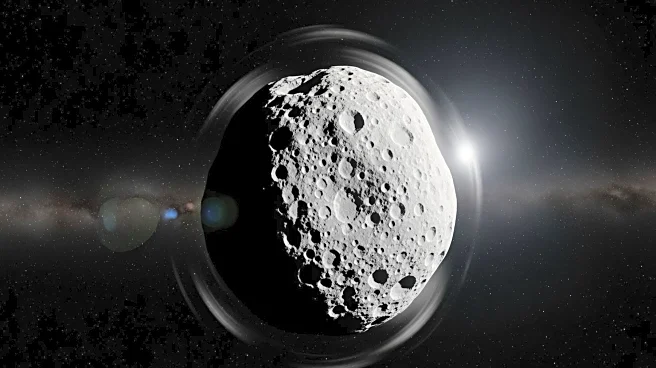
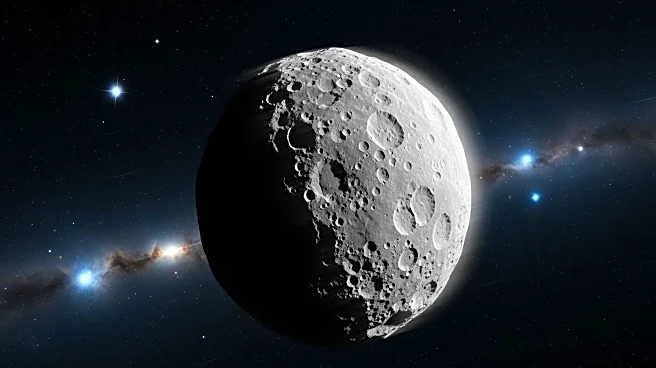
Astronomers have identified an asteroid, named 2025 MN45, that spins at an unprecedented speed of once every 1.9 minutes. This discovery was made by the Vera C. Rubin Observatory in Chile, marking it as the fastest-rotating large asteroid ever observed.
The asteroid measures approximately 710 meters in diameter, and its rapid rotation challenges previous assumptions about the structural integrity of such celestial bodies. Typically, asteroids are considered 'rubble piles,' composed of smaller rocks held together by gravity, which limits their rotational speed to about once every 2.2 hours. However, 2025 MN45's speed suggests it is made of a more solid material, possibly a single rock or metal, rather than a collection of smaller fragments. This finding was presented by Dmitrii Vavilov from the University of Washington at the Lunar and Planetary Science Conference in Texas.
Why It's Important?
The discovery of 2025 MN45 provides new insights into the composition and behavior of asteroids, which are crucial for understanding the formation and evolution of our solar system. The ability of this asteroid to maintain its structure at such high rotational speeds suggests the presence of more solid and cohesive materials than previously thought possible in large asteroids. This could have implications for future asteroid mining endeavors, as well as for planetary defense strategies, as understanding the physical properties of asteroids is essential for developing methods to deflect potential Earth-bound objects. Additionally, the findings challenge existing models of asteroid formation and stability, prompting further research into the diversity of asteroid compositions.
What's Next?
The Vera C. Rubin Observatory is expected to continue its survey of the southern sky over the next decade, potentially identifying more fast-rotating asteroids. This ongoing research will help astronomers refine their models of asteroid dynamics and composition. Further studies may involve detailed spectroscopic analysis to determine the exact material composition of 2025 MN45 and similar asteroids. These efforts will contribute to a broader understanding of the solar system's history and the potential for resource utilization in space exploration.