
What's Happening?
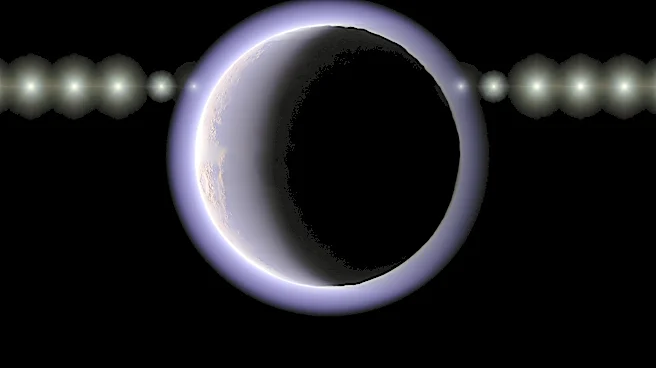
NASA's Juno spacecraft has captured a detailed image of Thebe, one of Jupiter's inner moons, during a close flyby on May 1, 2026. This mission, managed by NASA's Jet Propulsion Laboratory, aims to study
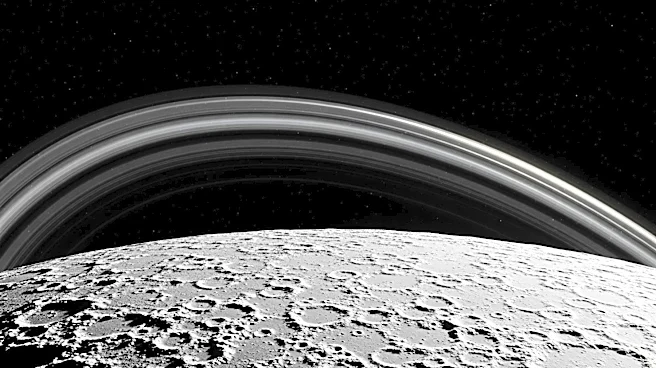
Jupiter's atmosphere and composition. The image reveals Thebe's role in the formation of Jupiter's 'gossamer' ring, a faint ring system composed of small particles. The Stellar Reference Unit (SRU) on Juno, primarily used for navigation, provided the high-resolution image, offering new insights into the moon's surface and its contribution to the ring system.
Why It's Important?
The discovery underscores the significance of smaller celestial bodies like Thebe in understanding planetary systems. By studying Thebe's influence on Jupiter's rings, scientists can gain insights into the dynamics of ring formation and maintenance. This knowledge could extend to other planetary systems, enhancing our understanding of the forces shaping moons and rings around gas giants. The Juno mission's innovative use of the SRU for scientific exploration highlights the potential for dual-purpose instruments in space missions, expanding the scope of data collection beyond initial expectations.
What's Next?
The Juno mission will continue to explore Jupiter and its moons, potentially leading to further discoveries about the planet's complex environment. Future studies may focus on other smaller moons and their contributions to Jupiter's ring system. The data collected could inform models of ring dynamics and influence the design of future missions to gas giants, aiming to unravel the mysteries of their moons and rings.