







What's Happening?
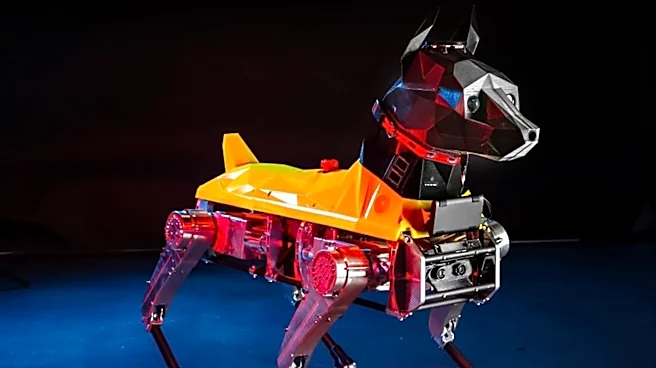
Chinese company Unitree Robotics, a major producer of humanoid and quadruped robots, has developed its successful robot dogs based on innovations initially funded by the U.S. military. According to a former U.S. defense technology official and three top
researchers involved in the original project, breakthroughs in quadruped movement financed by the U.S. DEVCOM Army Research Laboratory (ARL) and other military programs were foundational to Unitree's designs. Unitree's $1,600 Go2 model, launched in 2023, has enabled the company to dominate the global quadruped robot market. One of Unitree's robots has even been featured on Chinese state television, armed and accompanying People’s Liberation Army (PLA) troops during an exercise. This development highlights how U.S.-funded research can inadvertently contribute to the technological advancements of geopolitical rivals.
Why It's Important?
This situation underscores a critical challenge for U.S. national security and technological competitiveness. Investments in foundational research by the U.S. military, intended to benefit American defense capabilities, are being leveraged by foreign entities, specifically China, to develop advanced technologies with potential military applications. The rapid commercialization and mass production capabilities of Chinese companies like Unitree Robotics, which no U.S. company has matched for such robots, create a significant market disadvantage for American firms. This dynamic could lead to a scenario where U.S. military and commercial sectors become reliant on foreign-produced technology, or struggle to compete with lower-cost alternatives. The issue also raises questions about intellectual property protection and the balance between open scientific research and strategic technological safeguarding in an era of intense global competition.
What's Next?
U.S. policymakers are urged to focus on enabling American companies to rapidly commercialize advances from government-financed research to compete effectively with China. This could involve new policies to accelerate the transition of military-funded innovations to the commercial sector, or increased funding for domestic manufacturing and scaling capabilities. The U.S. government may also consider stricter controls on the dissemination of sensitive research findings or enhanced measures to prevent foreign entities from exploiting publicly available research for military purposes. The ongoing debate in Congress, as highlighted by Boston Dynamics' concerns about Chinese pricing driving U.S. firms out of the market, suggests that legislative action or new regulatory frameworks might be explored to address this competitive imbalance. The long-term goal will be to ensure that U.S. military research primarily benefits American interests and maintains a technological edge.
Beyond the Headlines
The phenomenon of U.S.-funded research propelling foreign technological advancements reveals a deeper systemic issue within the global innovation ecosystem. The traditional academic and scientific ethos of open publication and knowledge sharing, while beneficial for global progress, can be exploited by strategic competitors. This situation forces a re-evaluation of how publicly funded research, particularly in dual-use technologies, is managed and protected. It highlights the tension between the ideals of open science and the realities of geopolitical competition. Furthermore, it points to a potential gap in the U.S. innovation pipeline: while excellent at fundamental research, the U.S. sometimes struggles with rapid commercialization and scaling compared to countries like China. Addressing this will require not just policy changes but also a cultural shift in how research institutions, government agencies, and private industry collaborate to translate scientific breakthroughs into market-ready products that serve national interests.