







What's Happening?
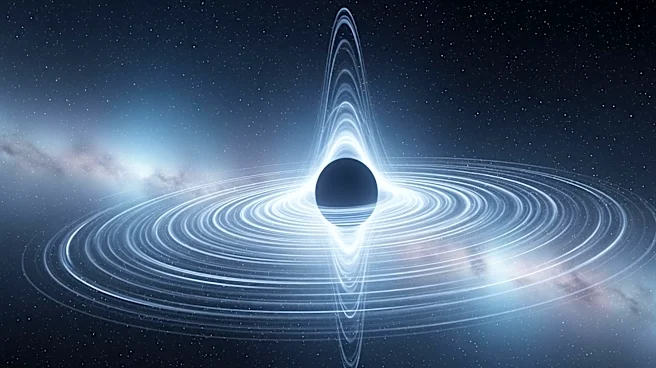
Recent gravitational wave detections by LIGO have provided potential evidence for primordial black holes, which may have formed during the Big Bang. These black holes, unlike those formed from dying stars, could account for dark matter, a mysterious component
of the universe. Researchers Nico Cappelluti and Alberto Magaraggia from the University of Miami suggest that a detected gravitational wave signal, indicating a collision involving a subsolar mass black hole, supports the existence of these primordial entities. This finding could offer a new perspective on the composition of dark matter.
Why It's Important?
The discovery of primordial black holes as dark matter candidates could revolutionize our understanding of the universe's composition. Dark matter, which makes up a significant portion of the universe, remains largely unexplained. Identifying primordial black holes as a component of dark matter could solve one of physics' greatest mysteries. This research could influence future studies in cosmology and particle physics, potentially leading to new theories about the universe's formation and evolution.
What's Next?
Further gravitational wave observations are needed to confirm the existence of primordial black holes. Upcoming enhancements to LIGO and other detectors like Virgo and KAGRA, as well as future projects like LISA, will improve sensitivity and detection capabilities. These advancements could provide more evidence to support the hypothesis and help distinguish primordial black holes from other astrophysical phenomena. Continued research will focus on gathering more data to solidify the connection between these black holes and dark matter.