





What's Happening?
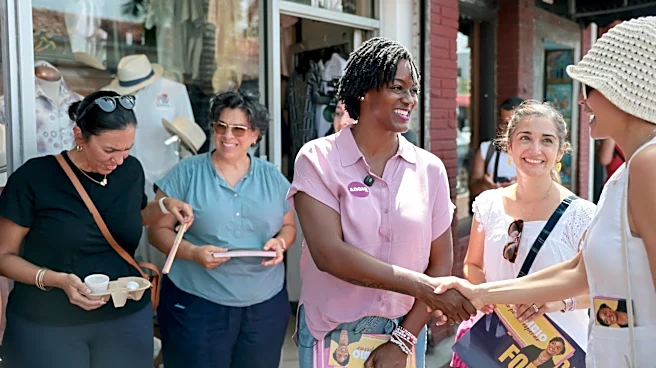
Following her loss in the Democratic primary for the Texas Senate race to James Talarico, Congresswoman Jasmine Crockett has drawn attention for her perceived lack of support for Talarico's campaign. Despite endorsing Talarico after the primary, sources
indicate that Crockett has not actively campaigned for him. This contrasts with a broader trend of unity among other Democrats who lost their primaries, such as Alexander Vindman in Florida, Francesca Hong in Wisconsin, and Haley Stevens and Mallory McMorrow in Michigan, all of whom have actively supported their party's nominees. Crockett reportedly refused to attend the Texas Democratic state convention to campaign for Talarico and publicly expressed doubts about his chances of victory, even though political analysts suggest Talarico has a strong chance based on polling data.
Why It's Important?
The apparent disunity within the Democratic Party in Texas, particularly concerning Congresswoman Crockett's actions, carries significant implications for the upcoming general election. A lack of enthusiastic support from a prominent figure like Crockett could dampen voter turnout and enthusiasm among her base, potentially hindering Talarico's ability to consolidate Democratic votes. This situation stands in stark contrast to the unified front presented by Democrats in other states, where primary losers are actively working to elect their party's nominees. The success of the Democratic Party often relies on its ability to present a united front against Republican opponents, and any perceived internal friction could be exploited by the opposition. This dynamic highlights the challenges of post-primary reconciliation and the importance of party cohesion in competitive races.
What's Next?
The ongoing narrative surrounding Congresswoman Crockett's level of support for James Talarico will likely continue to be a point of discussion as the general election approaches. Talarico's campaign will need to work to unify the Democratic base, potentially seeking to engage Crockett's supporters directly or through other party channels. The Democratic Party leadership, both in Texas and nationally, may also intervene to encourage greater cohesion and active campaigning from all members. The outcome of the Texas Senate race could be influenced by whether the party can overcome this perceived division and present a united front to voters. Political observers will be watching closely to see if Crockett's stance evolves or if the party finds alternative ways to galvanize support for Talarico.
Beyond the Headlines
This situation in Texas underscores a deeper challenge within political parties: the transition from competitive primary elections to a unified general election campaign. While primaries are designed to select the strongest candidate, the aftermath often requires significant effort to heal divisions and rally behind the chosen nominee. The contrast between Crockett's actions and those of other primary losers highlights different approaches to party loyalty and personal ambition versus collective party goals. This dynamic can affect not only individual election outcomes but also the long-term health and effectiveness of a political party. It raises questions about the role of individual politicians in fostering party unity and the potential consequences when personal grievances or perceived slights overshadow broader party objectives.