







What's Happening?
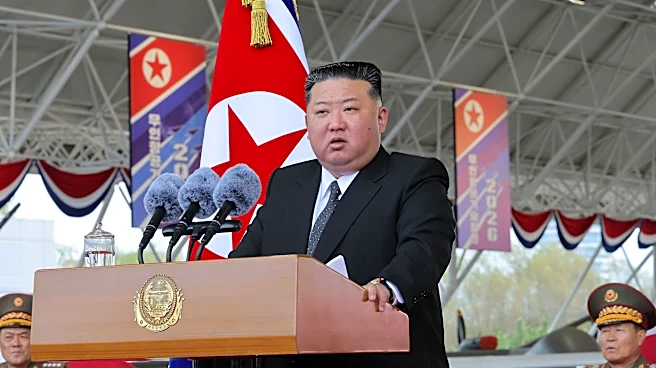
Kim Song-nam, a senior official and Political Bureau member of North Korea's Workers' Party of Korea (WPK), has arrived in China, leading a party delegation. This visit, confirmed by North Korea's state media, follows an invitation from China's Communist
Party's Central Committee. The delegation's arrival comes shortly after North Korean leader Kim Jong-un's surprise visit to Dandong, a Chinese border city. These high-level exchanges indicate a concerted effort by both nations to strengthen their traditional ties and cooperation. The relationship between Pyongyang and Beijing has seen renewed warmth, particularly after a period of cooling amid North Korea's closer alignment with Russia following the Ukraine war. Upon arrival, Kim Song-nam and his delegation were met by Deputy Head Sun Haiyan and other officials from the International Liaison Department of the Chinese party, as well as North Korean Ambassador to China Ri Ryong-nam. Concurrently, a delegation led by Xie Chuntao, executive vice president of the Party School of the Chinese party's central committee, arrived in Pyongyang, meeting with Ju Chang-il, a North Korean party secretary.
Why It's Important?
The visit of a high-ranking North Korean official to China, coupled with reciprocal visits, carries significant geopolitical implications, particularly for regional stability and U.S. foreign policy. The deepening cooperation between Pyongyang and Beijing could potentially alter the dynamics of international efforts to denuclearize North Korea. For the U.S., this renewed alliance might complicate sanctions enforcement and diplomatic initiatives aimed at curbing North Korea's nuclear and missile programs. China's support could provide North Korea with economic and political leverage, potentially reducing its isolation and making it less susceptible to international pressure. This development could also be viewed in the broader context of a shifting global power balance, where China and Russia are increasingly challenging U.S. influence. The U.S. and its allies, such as South Korea and Japan, might need to reassess their strategies for engaging with North Korea and managing regional security concerns, as a stronger Sino-North Korean bond could embolden Pyongyang.
What's Next?
The ongoing high-level exchanges between North Korea and China are likely to lead to further discussions on economic cooperation, security matters, and regional issues. These interactions could result in new agreements or strengthened existing partnerships, potentially impacting trade, infrastructure development, and military cooperation. The international community, particularly the U.S. and its allies, will closely monitor these developments for any signs of increased military collaboration or circumvention of international sanctions against North Korea. Future diplomatic efforts regarding North Korea's nuclear program may face additional complexities due to China's reinforced support. It is also possible that these visits will pave the way for a potential meeting between the leaders of China and North Korea, further solidifying their alliance and potentially leading to more coordinated actions on the international stage. The U.S. may respond by increasing diplomatic pressure on both nations or by strengthening its alliances in the Indo-Pacific region.
Beyond the Headlines
The re-strengthening of ties between North Korea and China extends beyond immediate political and economic benefits, touching upon historical and ideological solidarity. Both nations share a history of communist rule and have often found common ground in their opposition to perceived Western hegemony. This renewed cooperation could be seen as a strategic move by China to counter U.S. influence in Asia and to maintain a buffer state on its border, while North Korea gains a powerful ally to mitigate international isolation. The ethical implications involve the potential for human rights concerns in North Korea to be overshadowed by geopolitical considerations, as China's support might inadvertently enable the regime's repressive policies. Legally, the increased cooperation could test the limits of international sanctions regimes, requiring careful monitoring and potential adjustments by global bodies. Culturally, these exchanges could foster greater understanding and alignment between the two nations, reinforcing their shared narratives and potentially influencing regional perceptions of power and alliances.