
What's Happening?
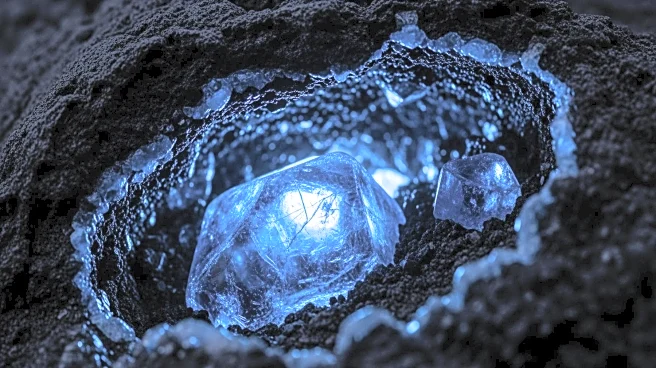
A study led by Prof. Zhixue Du from the Guangzhou Institute of Geochemistry of the Chinese Academy of Sciences has uncovered that large amounts of water may have been stored deep within Earth's mantle
during its early molten phase. This discovery challenges previous assumptions about the mantle's dryness and suggests that bridgmanite, a mineral abundant in the mantle, can store significant amounts of water. The research involved recreating extreme conditions found deep within the Earth and using advanced techniques to measure water content in mineral samples. The findings indicate that this deep water reservoir may have been crucial in transforming Earth from a hostile environment into a life-supporting planet.
Why It's Important?
Understanding the role of deep mantle water reservoirs is crucial for comprehending Earth's geological evolution and the development of its atmosphere and oceans. This research provides insights into how water facilitated internal geological processes, such as plate tectonics, which are essential for maintaining Earth's habitability. The study also impacts scientific models of Earth's formation and evolution, potentially influencing future research in geology and planetary science. By revealing the mantle's capacity to store water, the findings may lead to new theories about the distribution and movement of water within Earth's interior.
Beyond the Headlines
The discovery of water storage capabilities in bridgmanite could have broader implications for understanding other planetary bodies with similar geological compositions. It raises questions about the potential for water reservoirs on other planets, which could influence the search for extraterrestrial life. Additionally, the study highlights the importance of advanced scientific techniques in uncovering hidden aspects of Earth's geology, paving the way for further exploration of the planet's deep interior.