








What's Happening?
Astronomers have traced a high-energy neutrino, a type of ghost particle, to a distant galaxy nicknamed 'Shadow Blaster,' located 11 billion light-years away. Neutrinos are elusive particles that rarely interact with matter, making them difficult to study.
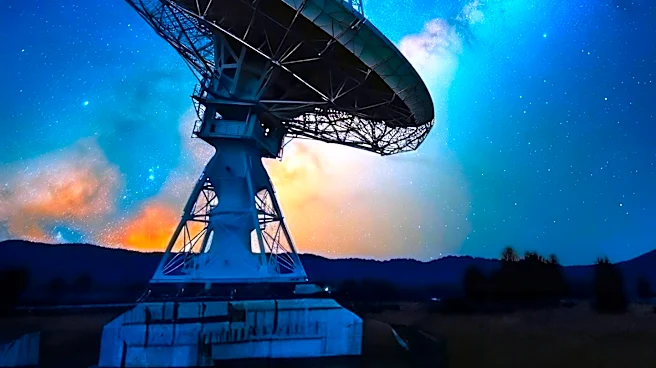
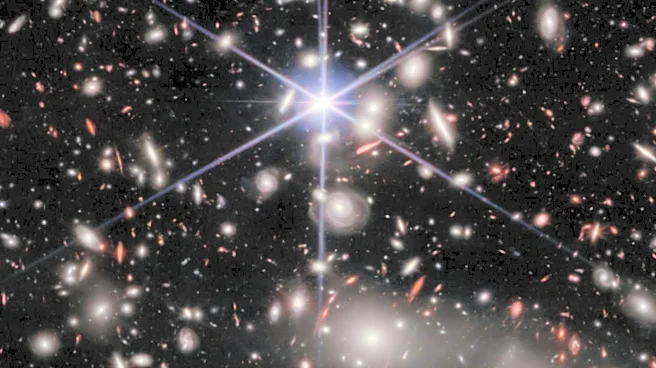
The discovery was made using the IceCube Neutrino Observatory in Antarctica, which detected the neutrino and prompted follow-up observations. The 'Shadow Blaster' galaxy, rich in star formation, was identified as the potential source of the neutrino. This finding marks a significant step in understanding the origins of neutrinos and their role in cosmic phenomena. The galaxy's location behind a gravitational lens allowed astronomers to study it in detail, revealing its potential as a source of high-energy particles.
Why It's Important?
This discovery is significant for the field of astrophysics as it provides new insights into the origins of neutrinos, which are fundamental to understanding cosmic events. Neutrinos can offer a unique perspective on the universe, acting like a 'super X-ray vision' to study phenomena obscured from traditional telescopes. The ability to trace neutrinos back to their sources could revolutionize the study of cosmic rays and the processes that generate them. This research also highlights the potential of using gravitational lensing to study distant galaxies, opening new avenues for exploring the universe's early history and the formation of stars and galaxies.
What's Next?
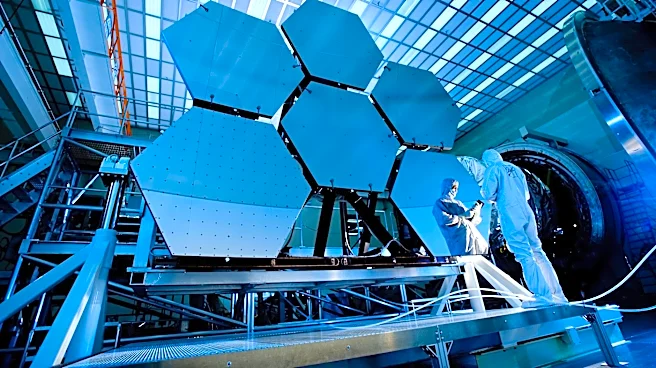
Future research will focus on confirming the connection between star-forming galaxies like 'Shadow Blaster' and high-energy neutrinos. Scientists aim to detect more such associations to establish these galaxies as significant sources of neutrinos. Observatories like the James Webb Space Telescope and ALMA will play a crucial role in these efforts, providing detailed observations of distant, dusty galaxies. Understanding the conditions that lead to neutrino production in these galaxies could offer new insights into the universe's evolution and the role of cosmic rays in shaping it.