
What's Happening?
Recent research has revealed that Neanderthal toddlers grew faster than modern human children, likely as an adaptation to the cold and harsh environments they inhabited. This conclusion was drawn from
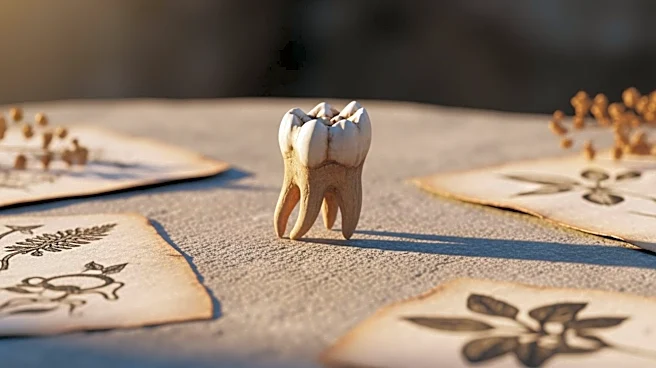
the study of a young Neanderthal's bones found in Amud Cave, northern Israel, dating back between 51,000 and 56,000 years. The study, published in the journal Current Biology, indicates that Neanderthals and modern humans diverged in their evolutionary paths after splitting from a common ancestor around 600,000 years ago. The partial skeleton, known as Amud 7, was discovered with a red deer jaw, suggesting a possible burial offering. Researchers found that while Neanderthal newborns were similar to modern human newborns in terms of tooth formation and limb length, their skulls were significantly larger. The study highlights that Neanderthal infants and toddlers experienced rapid body growth compared to their teeth, unlike modern humans whose growth was more proportionate.
Why It's Important?
This discovery provides significant insights into the evolutionary strategies of Neanderthals, emphasizing their adaptation to challenging environments. The rapid growth of Neanderthal children in their early years could have been a survival mechanism, allowing them to cope with the harsh conditions they faced. Understanding these differences in growth patterns between Neanderthals and modern humans can shed light on the evolutionary pressures that shaped human development. This research also contributes to the broader understanding of human evolution, highlighting the diverse adaptations of our ancestors to their environments. Such findings can influence current anthropological theories and prompt further studies into the developmental biology of ancient human species.
What's Next?
The researchers have called for more data from other non-adult Neanderthal skeletons to determine whether the rapid growth pattern observed in Amud 7 was widespread among Neanderthals or a specific adaptation to their environment. A larger sample size could provide a clearer picture of Neanderthal growth trajectories and their evolutionary strategies. Future studies may focus on comparing these growth patterns with those of other ancient human species to better understand the evolutionary pathways that led to modern humans. This ongoing research could also explore the genetic factors influencing growth and development in ancient populations.