


What's Happening?
Parkfield, a small ranching community in Central California with a population of 18, is known as the 'Earthquake Capital of the World' due to its location on the San Andreas Fault. The town experiences frequent, mostly minor, tremors and historically
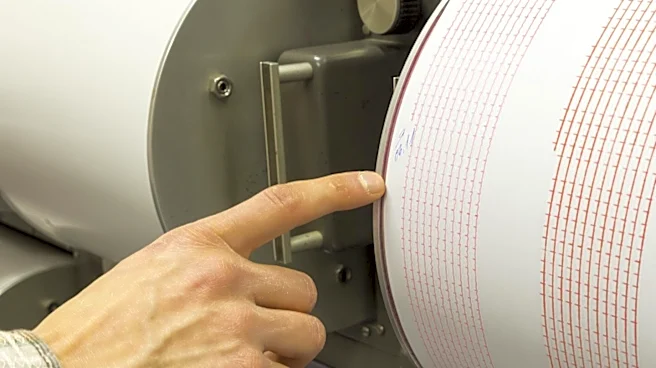
has a magnitude-6.0 earthquake approximately every 22 years. The most recent magnitude-6.0 quake occurred in September 2004, 38 years after the previous one in 1966. In the 1980s, the US Geological Survey initiated the Parkfield Experiment, installing extensive underground sensors and monitoring equipment to predict earthquakes. Despite these efforts, the anticipated quake did not occur as expected, highlighting the challenges in earthquake prediction. Today, Parkfield continues to serve as a vital real-life laboratory for scientists studying the movements of the San Andreas Fault.
Why It's Important?
Parkfield's unique geological position makes it a critical site for seismic research, offering invaluable data for understanding earthquake mechanics and potentially improving prediction methods. The ongoing study of the San Andreas Fault in Parkfield contributes to broader efforts to mitigate earthquake risks across California and other seismically active regions in the U.S. Improved understanding of fault line behavior can lead to better building codes, early warning systems, and public safety protocols, potentially saving lives and reducing economic damage from future seismic events. The town's history as a research site underscores the long-term commitment to scientific inquiry into natural disasters, benefiting urban centers and infrastructure vulnerable to earthquakes.
What's Next?
Parkfield is expected to continue its role as a key research site for seismologists studying the San Andreas Fault. Scientists will likely maintain and potentially expand the network of sensors and monitoring equipment to gather more data on seismic activity. The ongoing research aims to refine earthquake prediction models, although the Parkfield Experiment demonstrated the inherent difficulties in precise forecasting. Future efforts may focus on understanding the long-term patterns and irregularities of seismic events, rather than just short-term predictions. The data collected from Parkfield will inform geological studies and potentially influence public policy regarding earthquake preparedness and infrastructure development in California.
Beyond the Headlines
Beyond its scientific significance, Parkfield represents a unique intersection of natural phenomena and human resilience. The town's identity is deeply intertwined with its geological reality, fostering a community that lives with the constant presence of seismic activity. This situation raises questions about how communities adapt to and integrate high-risk natural environments into their daily lives. The historical efforts to predict earthquakes in Parkfield also highlight the limitations of scientific understanding and the unpredictable nature of geological processes, prompting a philosophical reflection on humanity's relationship with the natural world. Furthermore, the town's preservation of its 'Old West' charm amidst cutting-edge scientific research offers a cultural juxtaposition, showcasing how tradition and innovation can coexist.