








What's Happening?
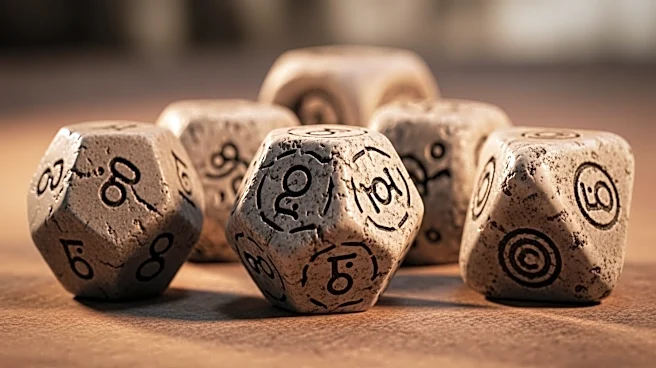
A new study has uncovered evidence that Native American hunter-gatherers were using dice for gaming and gambling over 12,000 years ago, significantly earlier than previously believed. Conducted by Robert Madden, a PhD student at Colorado State University,
the research suggests that these ancient groups had a basic understanding of chance and probability, using dice crafted from wood or bone. The findings challenge the traditional view that dice and probability were innovations of Old World societies, such as those in Mesopotamia and the Indus Valley. Madden's study, published in the journal American Antiquity, highlights the role of games of chance in facilitating social interactions and exchanges among disparate groups.
Why It's Important?
This discovery reshapes the understanding of the history of probabilistic thinking and gaming, highlighting the advanced cognitive abilities of ancient Native American societies. It suggests that these groups were early adopters of concepts related to randomness and probability, contributing to humanity's broader understanding of these ideas. The study also emphasizes the cultural significance of gaming as a tool for social bonding and exchange, offering insights into the social dynamics of prehistoric communities. By recognizing the sophistication of these early practices, the research challenges existing narratives about the development of mathematical concepts and their geographical origins.
Beyond the Headlines
The study opens up new avenues for archaeological research, encouraging scholars to re-examine artifacts previously overlooked or misclassified. It also raises questions about the cultural exchanges between ancient societies and the diffusion of gaming practices across regions. The findings may lead to a reevaluation of the role of games in the development of social structures and economic systems in prehistoric times. Additionally, the research highlights the importance of interdisciplinary approaches in uncovering hidden aspects of human history, combining archaeology, anthropology, and mathematics to provide a more comprehensive understanding of ancient cultures.