


What's Happening?
NASA's Expedition 74 is conducting a series of research activities aboard the International Space Station (ISS), focusing on robotics, physics, and heart health. The crew is involved in various tasks, including the maintenance of the Astrobee free-flying
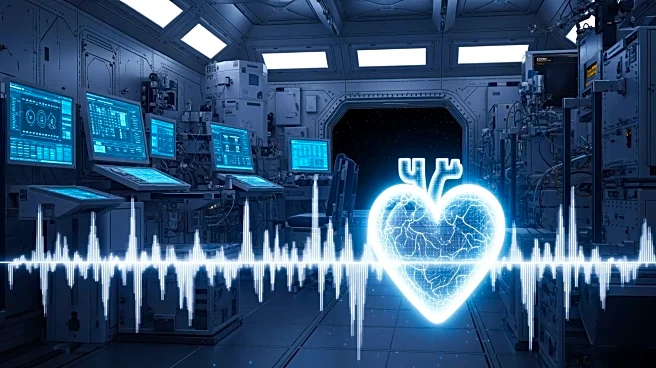
robotic helpers and experiments on liquid metal flow in microgravity. These activities aim to enhance space repair techniques and improve satellite thrusters. Additionally, the crew is working on a biotechnology experiment to advance pharmaceutical manufacturing in space. The research also includes studying the effects of microgravity on the endothelium, the thin layer of cells lining blood vessels, which could advance cardiac research on Earth. The crew is also preparing for the disposal of decommissioned hardware via the Japanese HTV-X1 cargo spacecraft.
Why It's Important?
The research conducted on the ISS has significant implications for both space exploration and Earth-based applications. The advancements in robotics and biotechnology could lead to improved space mission efficiency and new pharmaceutical manufacturing methods. Understanding the effects of microgravity on the human body, particularly the cardiovascular system, is crucial for ensuring astronaut health on long-duration missions. This research could also translate into better medical treatments and technologies on Earth. The disposal of obsolete hardware is part of maintaining the ISS's operational efficiency, ensuring that the station remains a viable platform for scientific research.
What's Next?
The crew will continue their research and maintenance activities, with the HTV-X1 cargo spacecraft scheduled to depart the ISS in late January, taking the decommissioned hardware with it. Future research will likely build on the current experiments, further exploring the potential of microgravity environments for scientific and technological advancements. The ongoing studies will contribute to NASA's broader goals of supporting long-term human exploration of space, including missions to the Moon and Mars.