

What's Happening?
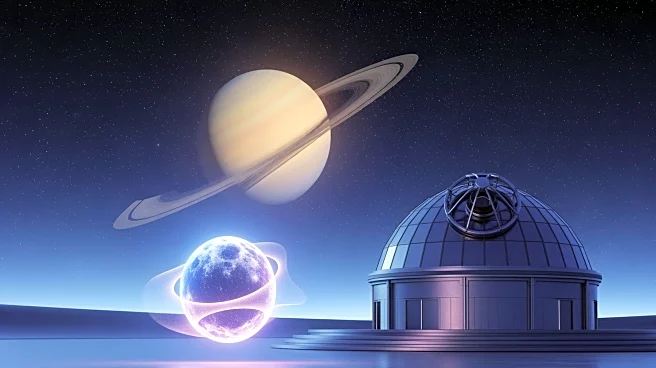
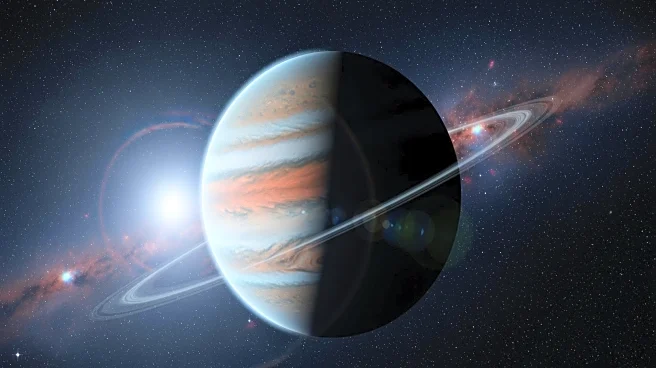
A new theory proposed by Matija Ćuk, a research scientist at the SETI Institute, suggests that a collision between one of Saturn's moons and Titan, its largest moon, may explain several of Saturn's unique characteristics. Ćuk's research, which combines
data from NASA's Cassini Probe and computer simulations, posits that an ancient moon collided with Titan, enlarging it and setting off a chain reaction. This event is believed to have caused Saturn's distinctive wobble, tilt, and possibly even its iconic rings. The theory challenges previous assumptions that Neptune's gravitational influence was responsible for Saturn's wobble. Ćuk's findings have been accepted for publication in The Planetary Science Journal.
Why It's Important?
This new theory provides a comprehensive explanation for some of Saturn's most puzzling features, which have long intrigued astronomers. Understanding the formation and evolution of Saturn's moons and rings can offer insights into the dynamics of planetary systems, including our own. The implications of Ćuk's research extend beyond Saturn, as it may influence how scientists interpret data from other celestial bodies and their interactions. The theory also highlights the importance of continued space exploration and data collection, as exemplified by the Cassini mission, in solving longstanding astronomical mysteries.
What's Next?
The acceptance of Ćuk's theory in a scientific journal suggests that further peer review and discussion will follow, potentially leading to new research initiatives. Astronomers may seek additional evidence to support or refute the theory, possibly through future space missions or advanced telescopic observations. The scientific community's response could drive new technological developments in space exploration, aiming to gather more detailed data on Saturn and its moons. This ongoing research may also inspire similar studies of other planetary systems, enhancing our understanding of the universe.