




What's Happening?
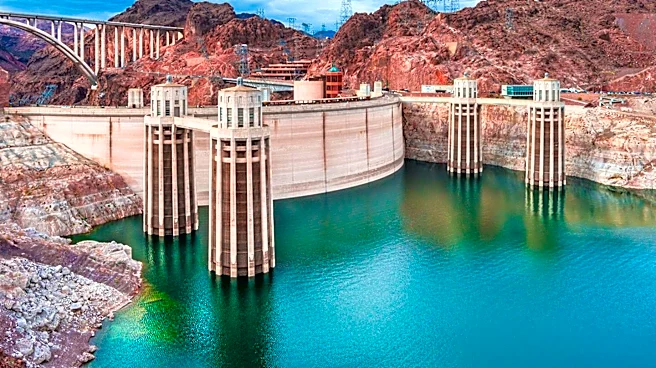
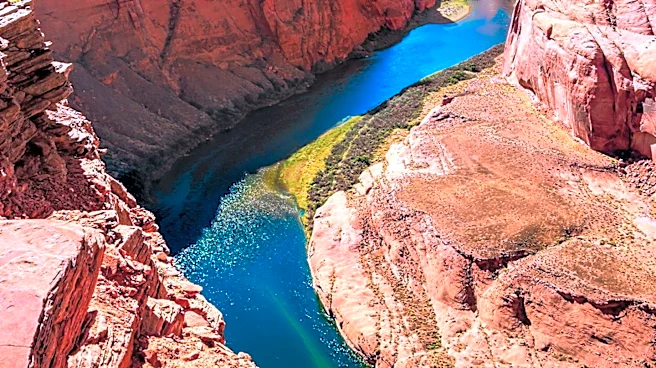
Lake Powell and Lake Mead, the two largest reservoirs in the Colorado River Basin, have plummeted to new historic lows. Lake Mead dropped to 1,040 feet, approximately 27% full, while Lake Powell reached an elevation of 3,519.91 feet, about 22% full and only
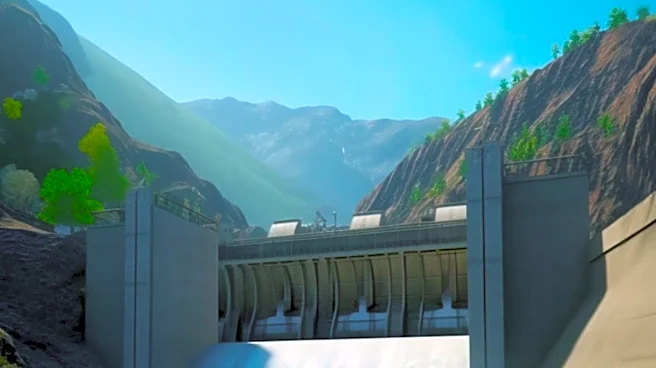
30 feet above the minimum power pool level required for hydroelectric power generation. These levels surpass previous records set in 2022 for Mead and 2023 for Powell. The last time their combined storage was this low was in 1957, during the construction of the Glen Canyon Dam. This critical situation follows a winter with only 22% of normal snowpack in the Upper Basin, and unregulated inflow into Lake Powell in June was just 12% of the 1991-2020 average. The U.S. Bureau of Reclamation has implemented emergency measures, including limiting releases from Lake Powell to the Lower Basin states and releasing water from Flaming Gorge Reservoir, an Upper Basin reservoir, to prevent further declines.
Why It's Important?
The dwindling water levels in Lake Powell and Lake Mead pose significant threats to the water supply for approximately 40 million people across seven U.S. states and Mexico. These reservoirs are crucial for the Lower Colorado River Basin states of Arizona, Nevada, and California, while Upper Basin states like Colorado, Wyoming, Utah, and New Mexico rely primarily on snowpack. The potential loss of hydroelectric power generation from Glen Canyon Dam, should Lake Powell fall below its minimum power pool level, would impact energy grids and increase costs for millions. Furthermore, the ongoing disagreements among the basin states regarding long-term water management, exacerbated by the Bureau of Reclamation's two-year operational framework, create uncertainty for water users. City water managers and farmers, who require long-term predictability for planning, are particularly affected by the lack of a stable, multi-year agreement. The current framework, while aiming to protect infrastructure, is criticized for fostering a cycle of crisis management rather than providing a sustainable path forward.
What's Next?
The current operating guidelines for the Colorado River reservoirs are set to expire this year, and the Bureau of Reclamation has released a final environmental impact statement to guide management in two-year increments through 2036. This framework is intended to provide a decision-making structure, but it has been met with skepticism due to its short-term nature. Stakeholders, including Sarah Porter, director of the Kyl Center for Water Policy, and Andy Mueller, general manager for the Colorado River District, argue that a two-year operating program offers insufficient certainty for long-term water planning. There are also concerns about potential legal challenges to parts of the environmental impact statement. While the framework allows for voluntary conservation programs in the Upper Basin, Lower Basin states could face mandatory cuts of up to 3 million acre-feet, with Arizona Governor Katie Hobbs expressing concerns that her state might bear the brunt of these cutbacks. The Bureau of Reclamation believes the two-year approach is necessary for adaptive management given the unprecedented conditions, but the fundamental disagreements among states over water rights and allocation remain unresolved.
Beyond the Headlines
The persistent drought and declining reservoir levels in the Colorado River Basin highlight a deeper challenge of managing vital natural resources in the face of climate change and increasing demand. The inability of the seven basin states to reach a consensus on long-term water management underscores the complex legal and political landscape surrounding water rights, particularly those established by the 1922 Colorado River Compact and the 1968 Colorado River Basin Projects Act. The current situation reveals a tension between immediate crisis management and the need for sustainable, long-term solutions. The reliance on short-term operational frameworks, while offering flexibility, may perpetuate a cycle of uncertainty and conflict, potentially leading to more severe water restrictions, economic disruptions, and environmental degradation in the future. This ongoing struggle also raises questions about the equity of water allocation and the need for innovative approaches to water conservation, reuse, and interstate cooperation to ensure the long-term viability of the Colorado River system.