




What's Happening?
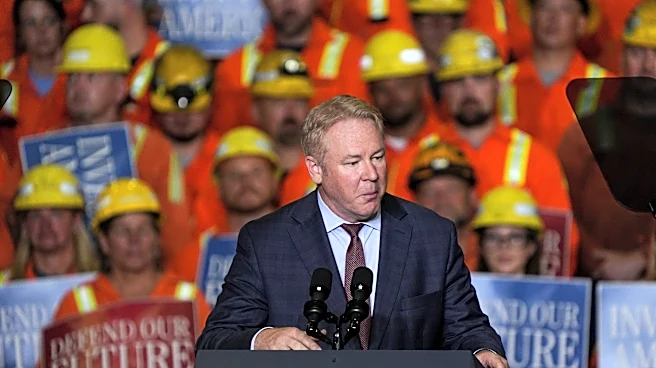
Jonathan Williams, President and Chief Economist of the American Legislative Exchange Council (ALEC), appeared on 'The Hugh Hewitt Show' to discuss critical issues facing U.S. states, including fiscal discipline and energy policy. Williams emphasized
the importance of proactive debt management by state policymakers, advocating for the implementation of fiscal rules at the federal level similar to the balanced budget requirements prevalent in most states. He highlighted that waiting for bond markets to impose discipline through rising interest rates is not an effective strategy. The conversation also touched upon what Hewitt termed 'ALEC envy,' noting that progressive organizations are attempting to emulate ALEC's success in developing policy solutions. Williams attributed ALEC's effectiveness to strong leadership, genuine member collaboration, and shared goals, contrasting it with what he described as a 'coalition of the coerced' on the left. Additionally, Williams discussed the ALEC Energy Academy in Kentucky, which focuses on strategies to achieve energy abundance to combat high costs and unreliable supply, stressing the need to increase energy supply to meet current demand for affordability and reliability.
Why It's Important?
The discussion underscores significant policy debates impacting the economic stability and energy security of the United States. Williams' call for federal fiscal rules mirrors a long-standing conservative push for greater financial accountability, which could profoundly alter federal spending and debt accumulation if adopted. The comparison between ALEC's operational model and attempts by progressive groups to replicate it highlights a broader ideological struggle over policy influence and legislative strategy in the U.S. The emphasis on energy abundance directly addresses current concerns about inflation and energy independence, suggesting that increased domestic supply is a key solution to affordability and reliability challenges. This perspective is crucial for industries reliant on stable energy prices and for consumers facing rising utility costs. The policy recommendations discussed could influence state and federal legislative agendas, potentially leading to shifts in economic and energy governance.
What's Next?
The ongoing advocacy by organizations like ALEC for fiscal discipline and energy abundance suggests continued pressure on state and federal lawmakers to adopt these policy frameworks. Policymakers are likely to face increasing calls to address national debt and energy supply issues, especially as economic pressures persist. The 'ALEC envy' phenomenon indicates that the competition for policy influence between conservative and progressive groups will intensify, potentially leading to more sophisticated and organized efforts from both sides to shape legislation. Future legislative sessions at both state and federal levels may see renewed efforts to introduce balanced budget amendments or similar fiscal constraints. Furthermore, discussions around energy policy will likely continue to focus on balancing environmental concerns with the need for affordable and reliable energy, with proponents of energy abundance pushing for policies that favor increased production and diversified energy sources.
Beyond the Headlines
The conversation between Hugh Hewitt and Jonathan Williams points to a deeper philosophical divide in American governance: the role of government in economic management and resource allocation. ALEC's emphasis on fiscal rules and supply-side energy solutions reflects a belief in market-driven efficiency and limited government intervention. Conversely, the 'coalition of the coerced' critique suggests a view that progressive policy efforts are less organic and more top-down. This ideological clash extends beyond specific policies to fundamental questions about how the U.S. economy should be structured and how societal challenges should be addressed. The debate over 'ALEC envy' also highlights the evolving landscape of political advocacy, where effective organizational models are sought after and replicated, indicating a strategic arms race in the realm of policy development and influence. The long-term implications involve the potential for significant shifts in economic policy, energy infrastructure, and the balance of power between federal and state governments.