


What's Happening?
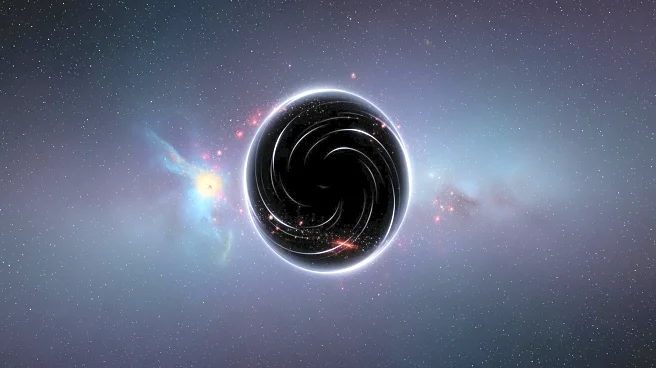
Astrophysicists from the University of Miami are investigating a recent gravitational wave signal detected by LIGO that suggests the existence of a subsolar-mass black hole. This finding could indicate the presence of primordial black holes, which are theorized
to have formed shortly after the Big Bang. These black holes, if confirmed, could provide insights into the nature of dark matter, which constitutes a significant portion of the universe's mass. The researchers believe that further detections are necessary to confirm the existence of these primordial black holes.
Why It's Important?
The potential confirmation of primordial black holes could revolutionize our understanding of the universe and the composition of dark matter. These black holes could account for a significant fraction of dark matter, providing a tangible explanation for this elusive component of the cosmos. The research could also validate theoretical models that have been proposed for decades, offering new insights into the early universe's conditions. This discovery could have profound implications for cosmology and physics, potentially leading to new theories and models.
What's Next?
Further observations and detections by LIGO and its international partners are needed to confirm the existence of primordial black holes. Upcoming upgrades to gravitational wave observatories, such as the European Space Agency's LISA and the U.S.-based Cosmic Explorer, will enhance detection capabilities, allowing scientists to probe deeper into the universe's history. These advancements could provide the necessary evidence to confirm the role of primordial black holes in dark matter composition, paving the way for new research and discoveries in astrophysics.