
What's Happening?
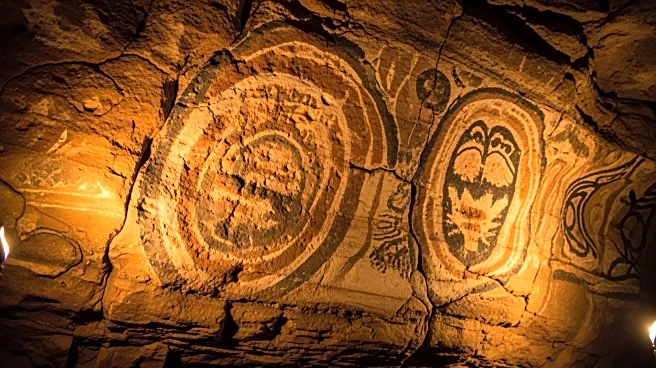
Researchers have discovered what is believed to be the world's oldest cave art in Indonesia, dating back at least 67,800 years. This ancient artwork, found in the Liang Metanduno cave on Muna Island, consists
of a handprint created by blowing a mixture of ochre and water over a human hand. The age of the handprint was determined using uranium-series analysis on calcium carbonate deposits surrounding it. This discovery surpasses the age of previously known ancient artworks, including a hand stencil in Spain attributed to Neanderthals. The findings suggest that the creators of this art may have been Homo sapiens, given the cognitive abilities required to produce such work.
Why It's Important?
The discovery of this ancient cave art has significant implications for understanding human migration and the development of cognitive abilities. It suggests that humans may have settled in Indonesia much earlier than previously thought, potentially revising the timeline of human migration to Australia. This finding challenges existing theories about the spread of Homo sapiens and their artistic expressions. It also provides insights into the cognitive development of early humans, indicating advanced thought processes and cultural practices. The research contributes to broader discussions in anthropology and archaeology about the origins and spread of human creativity and culture.
What's Next?
Further research is likely to focus on exploring other sites in Indonesia and surrounding regions to uncover more evidence of early human settlement and artistic expression. Scientists may also conduct additional analyses to refine the dating of the handprint and explore its implications for understanding human evolution. The discovery could prompt a reevaluation of migration patterns and timelines, influencing future archaeological and anthropological studies. Additionally, there may be increased interest in protecting and preserving these ancient sites to ensure they remain available for ongoing research and public education.
Beyond the Headlines
This discovery highlights the importance of interdisciplinary research in uncovering the complexities of human history. It underscores the role of art as a fundamental aspect of human identity and communication, offering a window into the lives and thoughts of our ancient ancestors. The findings may also inspire discussions about the cultural significance of art and its role in shaping human societies. As researchers continue to explore these ancient sites, they may uncover new insights into the social and environmental factors that influenced early human communities.