



What's Happening?
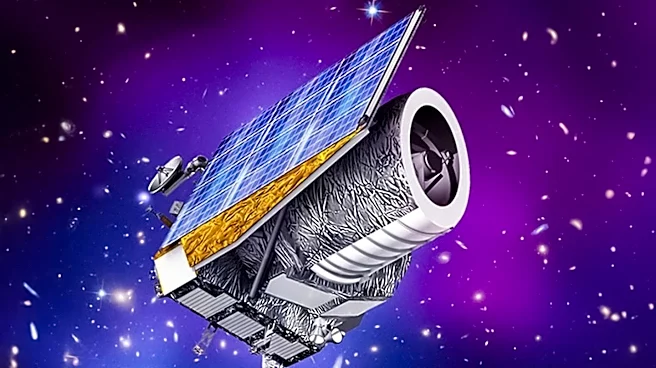
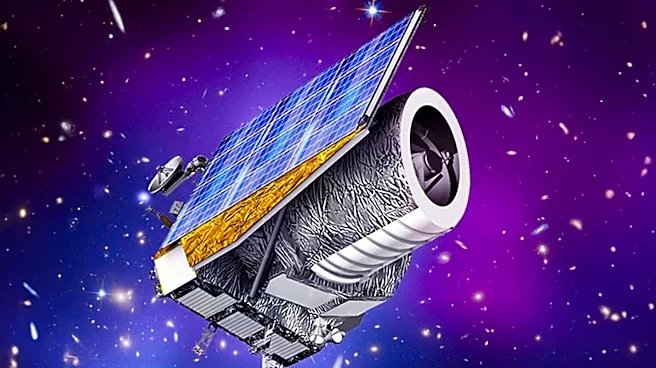
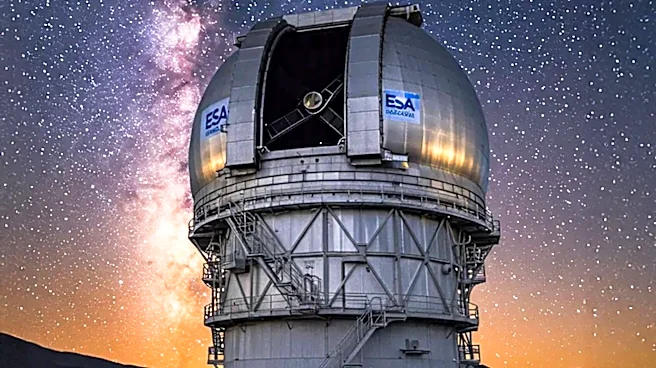
Astronomers have achieved the most precise measurement to date of the Milky Way's total mass, including its dark matter halo, by combining data from the Dark Energy Spectroscopic Instrument (DESI) and the European Space Agency's Gaia mission. Previous
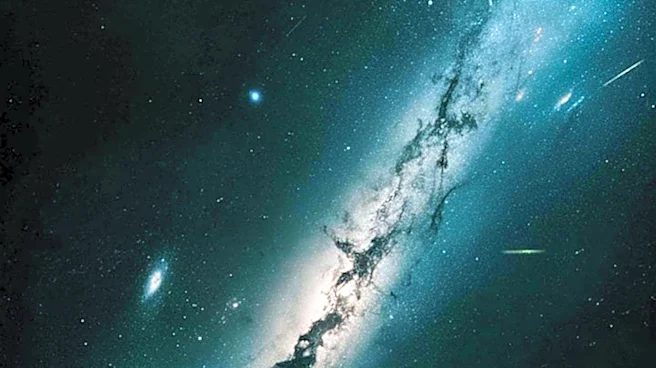
estimates for the Milky Way's mass varied widely, from 500 billion to nearly 2 trillion solar masses. The new study, leveraging DESI's spectroscopic measurements for line-of-sight stellar motion and Gaia's data for proper (transverse) stellar motions, focused on over 10,000 individual blue and RR Lyrae horizontal branch stars within the galactic halo, ranging from 33,000 to 312,000 light-years from the galactic center. By comparing the 3D positions and motions of these observed stars with 24 simulated galaxies of known masses, researchers robustly determined that within 80 kiloparsecs (260,000 light-years), the Milky Way contains 636 billion solar masses with an uncertainty of only 6-7%. Extrapolating to the entire galactic halo, the total mass is estimated at 1.19 trillion solar masses, with 10-12% uncertainties. This finding strongly disfavors previous suggestions of a 'light' Milky Way.
Why It's Important?
This precise measurement of the Milky Way's mass, particularly its dark matter halo, is a significant advancement in astrophysics. Dark matter, an invisible substance inferred from gravitational effects, constitutes a substantial portion of the universe's mass, and understanding its distribution within our own galaxy is crucial for validating cosmological models. The reduced uncertainty in this new estimate provides a more solid foundation for studying galactic dynamics, the formation and evolution of galaxies, and the nature of dark matter itself. It helps to constrain theoretical models of dark matter and could guide future experiments designed to detect dark matter particles. Furthermore, by ruling out a 'light' Milky Way, this research reinforces the prevalence and importance of dark matter in galactic structures. This improved understanding of our galaxy's mass directly impacts our comprehension of the universe's overall structure and evolution, influencing research priorities and potentially leading to new insights into fundamental physics.
What's Next?
The success of combining DESI and Gaia data for this precise measurement sets a precedent for future astronomical studies. Researchers will likely continue to refine these measurements, potentially by incorporating more distant halo stars or by developing even more sophisticated simulation and analysis techniques. The improved understanding of the Milky Way's dark matter halo will inform simulations of galaxy formation and evolution, allowing for more accurate predictions and comparisons with observational data. This research also opens avenues for investigating the properties of dark matter itself, as a more precise mass distribution can help constrain models of dark matter interactions. Future experiments, both ground-based and space-based, will aim to build upon these findings, potentially leading to direct or indirect detection of dark matter particles. The ongoing collaboration between large-scale survey projects like DESI and precise astrometry missions like Gaia will be instrumental in unraveling the remaining mysteries of our galaxy and the universe.
Beyond the Headlines
The ability to 'weigh' our galaxy with such precision, despite being embedded within it, is a testament to the ingenuity and technological advancements in modern astronomy. The concept of a vast, invisible dark matter halo surrounding our galaxy challenges our intuitive understanding of what constitutes 'matter' and highlights the limitations of observing only luminous objects. This research underscores the profound impact of dark matter on the universe's structure, from the smallest galaxies to the largest cosmic webs. The collaborative effort involving multiple observatories and advanced data analysis techniques reflects the increasingly interdisciplinary nature of scientific discovery. Beyond the scientific implications, this work contributes to humanity's ongoing quest to understand its cosmic home, pushing the boundaries of knowledge and inspiring future generations of scientists to explore the fundamental questions of existence and the universe's ultimate fate.