


What's Happening?
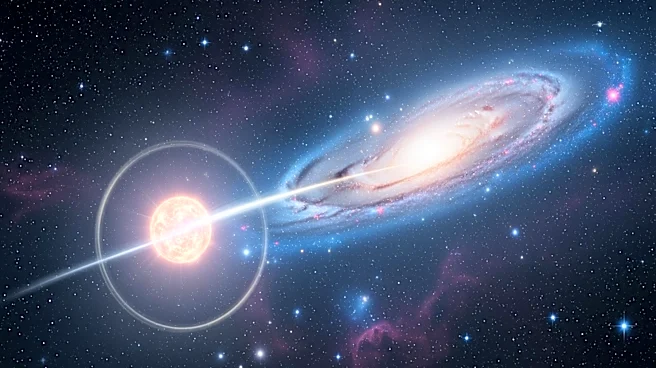
A group of undergraduate students from the University of Chicago has discovered one of the oldest known stars in the universe, which has migrated into the Milky Way from the Large Magellanic Cloud. This discovery was made using data from the Sloan Digital
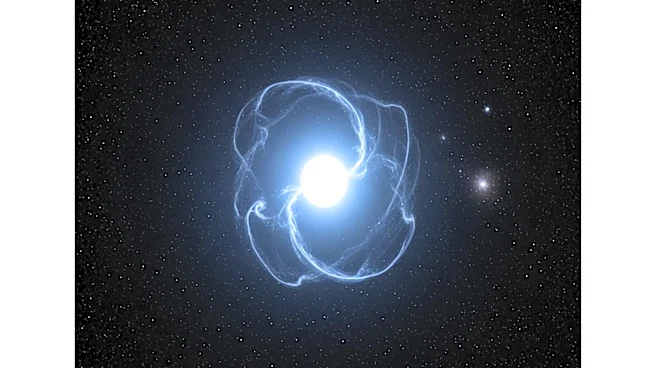
Sky Survey (SDSS) and further analyzed with the European Space Agency's Gaia mission. The star, identified as SDSSJ0715-7334, is composed almost entirely of hydrogen and helium, indicating its formation in the early universe. The students, under the guidance of Professor Alex Ji, identified the star during a field course in astrophysics. The star's low metallicity, with only 0.005 percent of the metals found in the Sun, marks it as the most metal-poor star ever observed, suggesting it belongs to the earliest generations of stars.
Why It's Important?
This discovery provides a rare glimpse into the conditions of the early universe, offering valuable insights into the formation and evolution of stars and galaxies. The identification of such an ancient star within the Milky Way helps astronomers understand the processes of galactic migration and the history of our galaxy's formation. The involvement of undergraduate students in this significant discovery highlights the importance of educational programs that integrate big data projects like SDSS, enabling students to contribute to groundbreaking research. This finding not only advances scientific knowledge but also inspires future generations of astronomers.
What's Next?
The discovery of SDSSJ0715-7334 opens new avenues for research into the early universe and the dynamics of galactic migration. Further studies will likely focus on analyzing the star's chemical composition and trajectory to gain deeper insights into its origins and the conditions of the early universe. The success of this student-led project may encourage similar educational initiatives, fostering a new wave of discoveries by involving students in large-scale astronomical surveys.
Beyond the Headlines
The discovery of such an ancient star raises questions about the processes that allowed it to migrate from the Large Magellanic Cloud to the Milky Way. This could lead to a better understanding of the gravitational interactions between galaxies and the role of dark matter in shaping galactic structures. Additionally, the star's unique chemical signature may provide clues about the early universe's chemical evolution and the formation of the first stars.