










What's Happening?
The article discusses the importance of accurately assessing population trends when planning for the future, particularly in the context of climate and energy scenarios. It highlights that the 21st-century population story is characterized by peak, plateau,
and divergence, rather than a continuation of the 20th-century doubling trend. The global population, which grew from 2.5 billion in 1950 to over 8 billion today, is expected to peak around 10.3 billion in the mid-2080s according to the United Nations World Population Prospects 2024. This projection is crucial for planning in areas such as electricity demand, urban infrastructure, and food systems. The article emphasizes that population assumptions should not be used as vague multipliers in long-range scenarios, as they significantly impact various sectors differently.
Why It's Important?
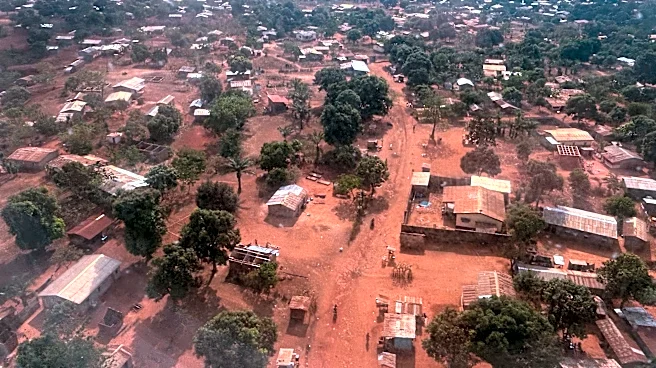
Understanding population trends is vital for effective planning in numerous sectors, including energy, infrastructure, and food systems. A miscalculation in demographic baselines can lead to inaccurate projections and ineffective policy decisions. The article stresses that population growth does not automatically equate to increased demand for fossil fuels, as factors like electrification and efficiency are changing the dynamics. Moreover, regional variations in population growth, such as the demographic momentum in Africa, require tailored approaches rather than a one-size-fits-all model. Accurate population modeling supports development goals like education, healthcare, and women's agency, which in turn influence demographic trends.
What's Next?
Future planning must incorporate a nuanced understanding of population dynamics, considering factors like fertility rates, urbanization, and regional differences. Policymakers and planners are encouraged to use a range of scenarios rather than relying solely on the UN's central projection. This approach will help address the specific service demands of each sector, ensuring that infrastructure and resource allocation are aligned with actual needs. As the world moves towards a peak population, the focus will likely shift towards maintaining and optimizing existing infrastructure rather than expanding it.
Beyond the Headlines
The discussion of population trends also touches on ethical considerations, as debates around population can lead to problematic political and moral implications. The article advocates for a focus on improving human well-being through education and healthcare, rather than viewing population as a problem to be managed. This perspective aligns with broader development goals and ensures that demographic changes are seen as a result of positive societal advancements.